
Published on: 19 Jan 2026
Comparing Single Head vs. Multi Head Embroidery Machines: A Factory Owner’s Comprehensive Guide
Key takeaways for garment factories:
- Single Head Machines: Ideal for sampling, prototyping, small-batch customization, and complex, unique designs, offering high flexibility with a lower initial investment.
- Multi Head Machines: Essential for high-volume production, standardized branding, and large orders, significantly reducing the cost per embroidered piece.
- Modern Technology: Both machine types benefit from advanced computerized controls, servo motors, and automation for enhanced precision and efficiency.
- Maintenance: Regular care, including cleaning, oiling, and timely troubleshooting, is crucial for machine longevity and consistent stitch quality.
- Strategic Partnership: Choosing a reliable machinery partner like DukeJia/HCA ensures robust after-sales support, installation, training, and genuine spares.
Table of Contents
- Understanding the Role of Embroidery in Garment Production
- Single Head Embroidery Machines: Flexibility for Diverse Needs
- Multi Head Embroidery Machines: Powering Volume Production
- Comparing Single Head vs. Multi Head Embroidery Machines
- Technical Considerations & Maintenance
- Troubleshooting Common Embroidery Faults
- Buying Guide & Selection Checklist
- Key Takeaways
- Frequently Asked Questions
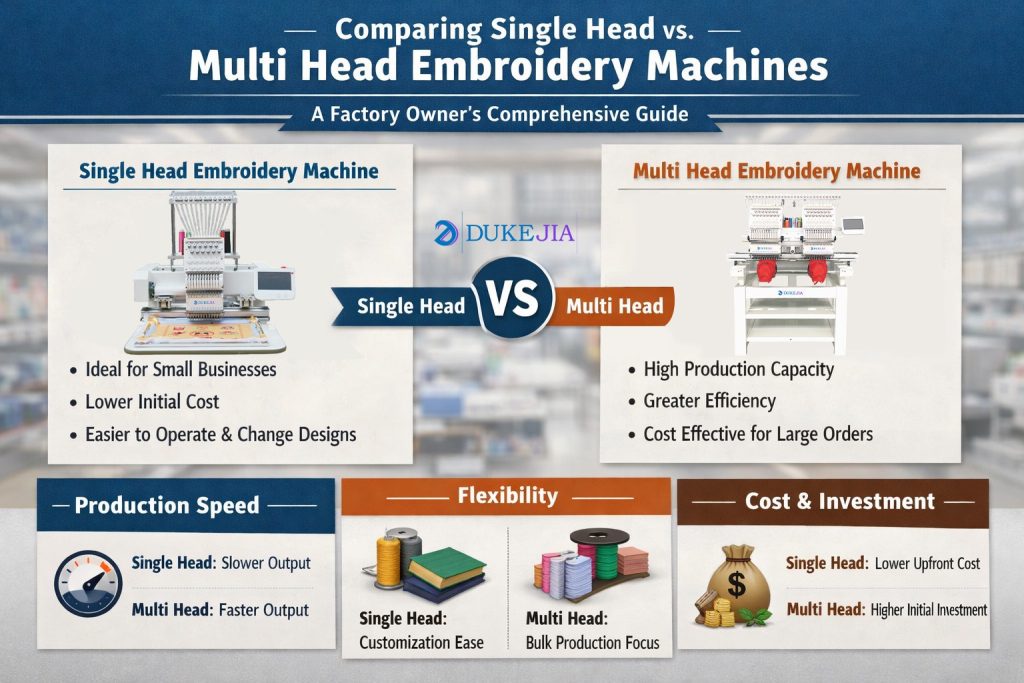
The setup in the image illustrates how a modern embroidery solution fits into a value-addition line within a garment factory. In the dynamic world of garment manufacturing, value addition is paramount for enhancing product appeal and improving margins. Industrial embroidery machines play a critical role in achieving this, allowing factories to personalize, brand, and embellish a wide range of textile products. Choosing the right machine, however, is crucial for operational efficiency and profitability. This article delves into comparing single head and multi head embroidery machines, offering insights for factory owners, production managers, and technical teams to make informed decisions.
Understanding the Role of Embroidery in Garment Production
Industrial embroidery machines are versatile assets, used extensively across various textile applications:
- Apparel: T-shirts, polos, knitwear, denim, jackets, caps, uniforms, activewear, and sportswear (e.g., team logos, branding, decorative motifs).
- Home Textiles: Towels, bed linen, curtains, decorative pillows (e.g., monograms, intricate patterns).
- Accessories: Bags, patches, footwear components.
These machines solve several common shop floor challenges:
- Differentiation: Creating unique designs that stand out in a competitive market.
- Branding: Consistent application of logos and brand elements.
- Customization: Fulfilling bespoke orders and small-batch production efficiently.
- Quality & Precision: Delivering sharp, consistent embroidery stitches crucial for a premium finish.
By integrating advanced embroidery capabilities, factories can command better Free On Board (FOB) prices and improve overall margins through enhanced product value.
Single Head Embroidery Machines: Flexibility for Diverse Needs
A single head embroidery machine features one embroidery head, meaning it can embroider one design at a time.
Working Principle & Components
The fundamental mechanism involves a needle, bobbin, and rotary hook working in conjunction to form a lockstitch. The fabric, held in a tensioned frame or hoop, moves precisely in X and Y directions according to the digitized design data. Key components include:
- Embroidery Head: Houses the needle bars (typically 9-15 for multi-colour designs).
- Needle Bar System: Controls the up-and-down motion of the needles.
- Rotary Hook System: Catches the needle thread to form the lockstitch with the bobbin thread.
- Tension Assemblies: Ensure consistent thread tension for both needle and bobbin threads.
- Pantograph/Frame Drive System: Stepper or servo motors precisely move the embroidery frame/hoop.
- Control Panel: User interface for loading designs, setting parameters, and monitoring the process.
Typical Use Cases
Single head machines excel in scenarios requiring high flexibility:
- Sampling & Prototyping: Ideal for creating initial design samples quickly.
- Small Batch Production: Economical for customized orders with low quantities.
- Complex or Large Designs: Often preferred for very large back-of-jacket designs or intricate appliqué work where the focus is on a single, high-quality output.
- Specialty Applications: Often used for caps, patches, or specific garment parts before assembly.
Production Capacity
Production speeds typically range from 600 to 1000 stitches per minute (SPM). Daily output can vary greatly, from 50 to 150 pieces depending on design complexity and stitch count.
Multi Head Embroidery Machines: Powering Volume Production
Multi head embroidery machines feature multiple embroidery heads working simultaneously and independently (or semi-independently) on the same design. This means multiple garments or garment parts can be embroidered concurrently.
Working Principle & Components
While each head operates like a single head machine, the entire system is synchronized by a central control unit.
- Multiple Heads: From 2 heads up to 24 heads or more, each capable of embroidering the same design simultaneously.
- Shared Pantograph or Individual Drives: Some systems use a common pantograph for all heads, while others have independent frame drives for more flexibility.
- Automated Features: Often include automatic thread trimming, automatic colour change, and advanced networking capabilities.
Typical Use Cases
These machines are the workhorses of large-scale production:
- High Volume Orders: Essential for factories handling thousands of pieces with identical or similar embroidery.
- Uniform Production: Efficiently adding logos to corporate uniforms, school uniforms, or sports team kits.
- Standardized Product Lines: Producing branded merchandise or private label goods with consistent design elements.
- Reducing Cost Per Piece: The simultaneous operation significantly lowers the cost per embroidered piece.
Production Capacity
While individual head speeds are similar (800-1200 SPM), the cumulative output is exponentially higher. A 12-head machine, for instance, can produce 12 embroidered pieces in roughly the same time a single head machine produces one. Daily output can range from 300 to over 1500 pieces, depending on the number of heads and design.
Comparing Single Head vs. Multi Head Embroidery Machines
| Feature | Single Head Embroidery Machine | Multi Head Embroidery Machine |
|---|---|---|
| Initial Investment | Lower | Significantly Higher |
| Production Volume | Low to Medium; ideal for samples, small batches, custom orders | High; essential for mass production, large volume orders |
| Flexibility | High; easily switch between different designs/garment types | Moderate; optimized for running the same design across many pieces |
| Space Requirement | Less | More |
| Operator Skill | Moderate to High (managing individual pieces/designs) | Moderate (monitoring multiple heads, efficient loading) |
| Labour Efficiency | Lower per piece | Higher per piece, reduced labour cost per unit |
| Running Cost | Higher per piece (due to lower throughput) | Lower per piece (due to simultaneous production) |
| Maintenance | Simpler, less complex | More complex, requires specialized knowledge |
| Best For | Design development, prototyping, bespoke orders, varied jobs | Mass production, consistent branding, bulk orders |
Technical Considerations & Maintenance
Regardless of the configuration, the performance and longevity of an industrial embroidery machine depend on its technical prowess and proper maintenance. Modern machines, whether from Japanese, European, or leading Chinese manufacturers, often feature:
- Computerized Control: Fully computer-controlled systems for precise stitch placement, automatic thread trimming, colour changes, and pattern memory.
- Servo Motors: Provide higher accuracy, speed, and energy efficiency compared to older stepper motor systems.
- Networking: Ability to load designs via USB, Ethernet, or wireless networks, enhancing workflow.
- Build Quality: Reputable Chinese manufacturers like DukeJia now offer robust machines with build quality and precision comparable to established brands, but often at a more competitive price point, making them excellent value-addition machinery partners.
Daily Care & Maintenance
- Needles: Regular inspection and replacement of bent or dull needles prevent thread breaks and fabric damage.
- Thread Path: Ensure all tension discs and thread guides are clean and free of lint.
- Cleaning: Daily removal of lint and debris from the rotary hook area, tension assemblies, and machine bed.
- Oiling: Adhering to the manufacturer’s oiling schedule for moving parts, especially the rotary hook and needle bars.
- Calibration: Periodic checks and calibration of thread tension, timing, and frame movement for consistent stitch quality.
Troubleshooting Common Embroidery Faults
| Fault | Likely Causes | Basic Solutions |
|---|---|---|
| Thread Breaks | Incorrect tension, dull/bent needle, poor thread quality, lint in path, wrong needle size. | Adjust tension, replace needle, clean thread path, use quality thread. |
| Poor Stitch Quality | Incorrect tension (too loose/tight), dull needle, worn bobbin case, improper hooping. | Adjust top/bobbin tension, replace needle/bobbin case, re-hoop fabric tightly. |
| Skipped Stitches | Bent/dull needle, improper needle insertion, timing issues, wrong thread/needle combination. | Replace needle, ensure correct needle orientation, check machine timing (professional help). |
| Design Misalignment | Loose hooping, frame slippage, pantograph issues, incorrect design loading. | Re-hoop fabric securely, check frame clamps, verify design origin. |
| Fabric Damage | Dull/wrong needle type, incorrect tension, pushing fabric too hard during hooping. | Use correct needle for fabric, adjust tension, gentle hooping. |
Buying Guide & Selection Checklist
When considering an industrial embroidery machine, factor in these points:
- Production Volume: Do you need high output (multi-head) or flexibility for varied, smaller orders (single head)?
- Design Complexity & Size: Will you be running intricate multi-colour designs, or simple logos?
- Budget & ROI: What is your initial investment capacity, and what return do you expect? Consider the cost per piece in the long run.
- Space Availability: Do you have enough floor space for a larger multi-head system?
- Automation Needs: Are automatic trimming, colour changes, and networking crucial for your workflow?
- After-Sales Support: Critically evaluate the supplier’s commitment to installation, training, genuine spares, and on-call service. This is where partners like DukeJia and HCA truly add value.
- Fabric Types: Ensure the machine can handle the range of fabrics you intend to embroider.
Key Takeaways
- Single Head Machines: Offer flexibility, ideal for samples, small batches, and complex, single-piece designs. Lower initial investment.
- Multi Head Machines: Drive high-volume production, reduce cost per piece, and are essential for mass branding. Higher initial investment but better long-term ROI for scale.
- Modern Technology: Both types benefit from computerized controls, servo motors, and automated features, enhancing precision and efficiency.
- Maintenance is Key: Regular care and timely troubleshooting are vital for machine longevity and consistent stitch quality.
- Strategic Partnership: Choosing the right machinery partner is as important as the machine itself, ensuring seamless operations and expert support.
Frequently Asked Questions
What is the primary difference between a single-head and a multi-head embroidery machine?
A single-head machine embroideries one design at a time, offering flexibility for varied jobs and prototyping. A multi-head machine has multiple heads working simultaneously on the same design, ideal for high-volume production and consistent branding across many pieces.
Which type of embroidery machine is more suitable for a new garment factory or a startup?
For startups or new factories with limited budget and varied small orders, a single-head embroidery machine might be more suitable due to its lower initial investment and high flexibility. As production demands grow, investing in multi-head machines becomes more viable for scaling operations.
Can DukeJia/HCA embroidery machines handle diverse fabric types, from delicate knits to heavy denim?
Yes, DukeJia embroidery machines are designed with robust engineering and advanced controls to handle a wide range of fabric types, including knits, woven fabrics, denim, leather, and specialty materials. Proper needle selection, tension adjustment, and hooping techniques are key to successful embroidery across different fabrics.
What kind of after-sales support can I expect from DukeJia/HCA in India?
DukeJia, represented by HCA in India, provides comprehensive after-sales support. This includes professional installation, in-depth operator training, easy access to genuine spare parts, and responsive on-call service teams across major textile hubs to ensure minimal downtime and smooth operations.
Besides embroidery, does DukeJia/HCA offer machines for other value-addition processes like perforation or quilting?
Absolutely. DukeJia and HCA are dedicated value-addition machinery partners, supplying and servicing industrial embroidery, perforation, and quilting systems. This allows factories to integrate multiple processes like precise logo embroidery, intricate appliqué, all-over quilting for jackets, and specialized sportswear perforation.
For DukeJia embroidery, perforation or quilting machine demonstrations, pricing or technical consultation, contact Hari Chand Anand & Co. (HCA), New Delhi.