
Published on: 09 Feb 2026
Perforation Design Tips for Activewear Manufacturers (Drill/Knife Perforation): Breathability, Stretch, and Strength
Key Takeaways
Key takeaways for garment factories:
- Perforation is a critical value-addition technique for activewear, significantly enhancing breathability, optimizing stretch, and maintaining garment strength for improved wearer comfort and performance.
- Modern drill and knife perforation systems, supplied by DukeJia (HCA), offer high precision, speed, and design flexibility to meet the evolving demands of the activewear market.
- Strategic design of perforation patterns, considering material type, placement in high-sweat zones, and appropriate hole size/pitch, is essential to achieve functional and aesthetic goals without compromising durability.
- Investing in advanced, computer-controlled perforation machines ensures higher quality output, reduces operational inefficiencies, and enables factories to offer specialized, higher-margin products.
- Regular maintenance of perforation machinery and leveraging comprehensive after-sales support from DukeJia (HCA) are crucial for consistent performance, extended machine lifespan, and minimal downtime.
Table of Contents
- Key Takeaways
- Why Perforation Matters in Activewear Production
- Understanding Drill and Knife Perforation Technologies
- Design Principles for Perforated Activewear
- Modern Perforation Systems vs. Older Methods
- Maintenance and Daily Care for Perforation Machines
- Troubleshooting Common Perforation Issues
- Buying Guide: Selecting the Right Perforation Machine
- Frequently Asked Questions
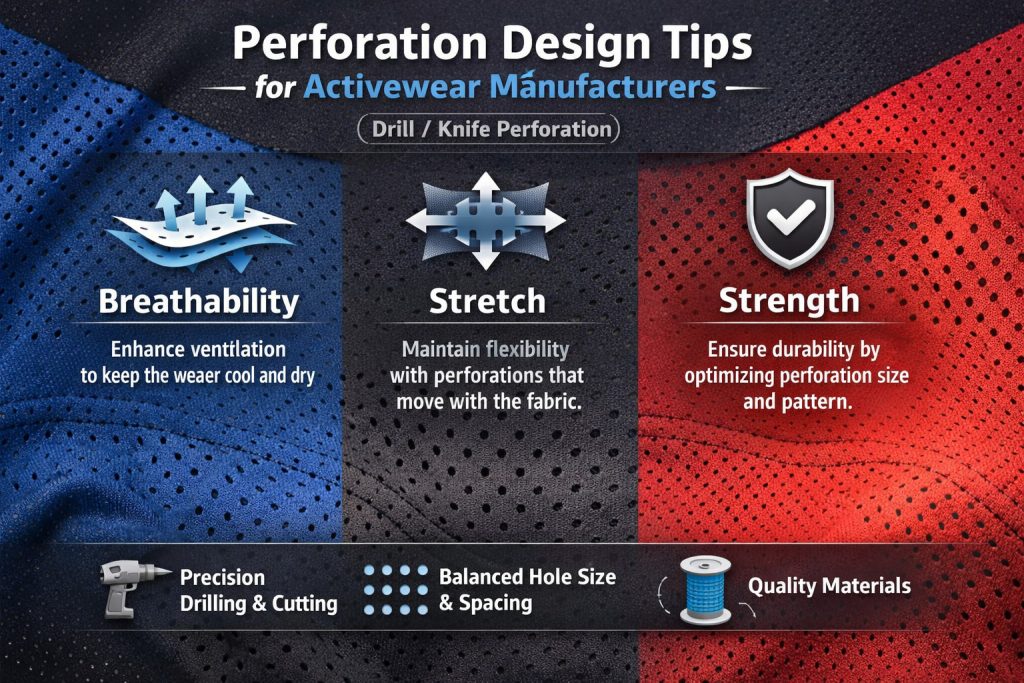
The activewear market demands innovative design and advanced functionality. Manufacturers are constantly seeking ways to enhance garment performance, user comfort, and aesthetic appeal to gain a competitive edge. The setup in the image illustrates how a modern industrial perforation system fits into a value-addition line, enabling garment factories to achieve these goals. This article focuses on Perforation Design Tips for Activewear Manufacturers (Drill/Knife Perforation): Breathability, Stretch, and Strength, offering insights for factory owners, production managers, industrial engineers, and maintenance teams.
Perforation, the process of creating small, precisely placed holes in fabric, is a critical value-addition technique for performance apparel. It’s extensively used in sportswear, leggings, running tops, cycling jerseys, and even certain jackets to improve ventilation and moisture management. Strategically applied, perforation solves common shop floor challenges related to material breathability without compromising garment integrity.
Why Perforation Matters in Activewear Production
Integrating perforation technology directly impacts a factory’s ability to deliver high-quality, high-value activewear.
Enhanced Breathability
The primary benefit. Perforated panels allow air to circulate freely, dissipating heat and sweat, which is crucial for high-intensity activities. This directly translates to improved wearer comfort and performance, distinguishing premium activewear.
Optimized Stretch and Fit
When designed correctly, perforation can work with a fabric’s natural stretch properties, allowing for greater freedom of movement without causing material distortion. It’s vital to design perforations that do not inhibit, but rather complement, the fabric’s stretch characteristics in critical zones.
Maintained Strength and Durability
A common concern is that perforating fabric might weaken it. Modern drill and knife perforation systems, combined with intelligent design, ensure that the fabric’s structural integrity is maintained, preventing tearing during wear and repeated washing.
Value-Addition and Higher Margins
Offering perforated designs elevates a product from basic to specialized. This value-addition allows factories to command a better FOB (Free On Board) price and achieve healthier profit margins, moving beyond commodity manufacturing.
Aesthetic Appeal
Beyond function, perforations add a sophisticated design element, creating unique textures and patterns that enhance visual appeal and brand identity.
Understanding Drill and Knife Perforation Technologies
DukeJia, represented in India by Hari Chand Anand & Co. (HCA), supplies and services industrial perforation systems designed to meet these demands. The core technologies for mechanical perforation are drill and knife-based.
Drill Perforation
Working Principle
Utilizes an array of rapidly rotating drills (or punches) that create circular holes by cutting and removing small fabric particles. The fabric is typically held taut and fed under the drilling head.
Key Components
Multi-spindle drilling head with individual drill bits, material clamping/feeding system (often vacuum-assisted or with precise rollers), and a computer-controlled XYZ movement system for pattern execution. Waste material (fabric dust/chads) is usually removed via a vacuum system.
Advantages
High speed for repetitive circular patterns, good for various fabric types (knits, wovens, synthetics), can create very small holes. Excellent for all-over uniform breathability patterns.
Considerations
Drill bit wear is a factor, requiring regular replacement based on material and usage. Some fabrics may fray slightly if drill bits are dull.
Knife (Die) Perforation
Working Principle
Employs sharp knives or dies that punch through the fabric to create holes or shapes. This is similar to a die-cutting process. The fabric is pressed against a cutting surface by the knife array.
Key Components
A press mechanism, interchangeable die sets (customizable for various hole shapes like squares, slots, or even complex logos), a material feeding system, and a cutting bed or anvil.
Advantages
Creates very clean, precise cuts with minimal fraying, can produce non-circular shapes, and is excellent for materials where a crisp edge is paramount. Good for materials like faux leather, composites, and some stable wovens.
Considerations
Tooling is pattern-specific, making it less flexible for varied designs compared to drill systems without changing dies. Speed can be dependent on the press cycle.
Modern perforation machines from DukeJia are fully computer-controlled, allowing for programmable patterns, variable hole sizes, and precise placement, adapting to different activewear designs. Typical production capacities range from several hundred to thousands of perforations per minute, depending on the pattern density and machine configuration, enabling efficient high-volume output.
Design Principles for Perforated Activewear
When designing for breathability, stretch, and strength using perforation, consider these technical aspects:
Strategic Placement for Breathability
- High-Sweat Zones: Focus perforations on areas like the back, underarms, chest, and inner thighs where sweat accumulation is highest.
- Directional Airflow: Design patterns to encourage airflow in specific directions, aiding evaporative cooling.
- Body Mapping: Use body-mapping data to identify areas requiring maximum ventilation based on garment type and intended activity.
Optimizing for Stretch and Movement
- Fabric Type: Understand the fabric’s stretch percentage and recovery. Perforations on high-stretch fabrics (e.g., elastane blends) need careful consideration to avoid tearing or compromising elastic recovery.
- Perforation Orientation: Align elongated holes or patterns with the direction of maximum stretch to minimize resistance. Avoid large, dense perforations in areas of extreme stretch where material integrity is critical.
- Edge Finish: Ensure clean edges to prevent snagging or laddering, especially important on fine gauge knits. Knife perforation often excels here.
Ensuring Strength and Durability
- Hole Size and Pitch: The ratio of hole size to the fabric “bridge” (unperforated material) is crucial. A smaller hole with a generous bridge maintains strength. Avoid very large holes or holes placed too close together.
- Material Compatibility: Some fabrics, particularly unstable knits or loosely woven materials, may be more prone to fraying or tearing. Test different perforation methods and designs on samples.
- Reinforcement: In high-stress areas, consider reinforcing the perforated panel from behind with a mesh or bonding agent, or integrate the perforation into stronger fabric sections.
- Pattern Distribution: Distribute perforation patterns evenly to avoid creating single points of stress.
Modern Perforation Systems vs. Older Methods
| Feature | Older, Mechanical Systems (e.g., manual punch) | Modern, Computer-Controlled Systems (DukeJia/HCA) |
|---|---|---|
| Pattern Flexibility | Limited to fixed dies/templates, manual setup | Infinitely programmable patterns, on-the-fly changes |
| Precision & Repeatability | Variable, operator-dependent, lower accuracy | High precision, consistent results across batches |
| Setup Time | Long, involves manual jig/die changes | Fast, digital pattern loading |
| Material Handling | Manual feeding, potential for distortion | Automated, tension-controlled feeding, minimal distortion |
| Speed & Throughput | Lower | High speed, optimized production cycles |
| Complexity of Designs | Simple, geometric | Complex, intricate, gradient patterns |
| Maintenance | Tooling wear, manual adjustments | Automated diagnostics, modular components |
| Energy Efficiency | Generally lower efficiency | Optimized power consumption |
| Data Integration | None | Connectivity to factory management systems (Industry 4.0 ready) |
Investing in modern perforation systems is justified when high volume, complex patterns, superior quality, and flexibility are required. These machines reduce operator error, enhance efficiency, and ultimately lead to a higher-quality, more competitive product.
Maintenance and Daily Care for Perforation Machines
Regular maintenance is key to ensuring consistent quality, maximizing machine lifespan, and minimizing downtime.
- Tooling Inspection: Regularly inspect drill bits or knife dies for sharpness, damage, or wear. Dull tools can lead to frayed edges, incomplete perforations, or fabric distortion. Replace worn tools promptly.
- Cleaning: Daily cleaning of the working area, especially vacuum systems for drill perforation, is crucial to remove fabric dust and waste. Accumulated debris can affect machine movement and product quality.
- Lubrication: Follow manufacturer guidelines for lubricating moving parts and bearings. Proper lubrication reduces friction and wear.
- Calibration Checks: Periodically verify the alignment and calibration of the perforation head and material feeding system to ensure pattern accuracy and consistent hole placement.
- Material Handling System: Inspect rollers, clamps, and tensioning devices for wear or damage. Ensure the material feeding system is free of obstructions and maintains consistent tension.
- Software Updates: Keep the control software updated to benefit from performance enhancements and new features.
DukeJia (HCA) provides comprehensive after-sales support, including installation, operator training, preventive maintenance schedules, genuine spare parts, and on-call service teams to ensure your machines operate at peak performance.
Troubleshooting Common Perforation Issues
| Common Fault | Likely Cause(s) | Basic Solution(s) |
|---|---|---|
| Incomplete Perforations | Dull drill bits/knives; insufficient pressure; worn cutting mat | Replace tools; adjust press pressure; replace cutting mat |
| Frayed Edges | Dull drill bits/knives; incorrect material tension; wrong tool for fabric | Replace tools; adjust tension; try different tool type |
| Fabric Distortion/Stretching | Incorrect material tension; misaligned feed; wrong feed speed | Adjust tension settings; check feed alignment; optimize speed |
| Pattern Inaccuracy | Calibration issues; worn mechanical components; software glitch | Recalibrate machine; inspect for wear; restart software/machine |
| Machine Overheating | Lack of lubrication; blocked ventilation; excessive continuous operation | Lubricate as per schedule; clean vents; allow cooling breaks |
| Excessive Noise | Worn bearings; loose components; lack of lubrication | Inspect and replace worn bearings; tighten components; lubricate |
For persistent or complex issues, always consult the machine’s technical manual or contact DukeJia (HCA) service team.
Buying Guide: Selecting the Right Perforation Machine
When considering an industrial perforation machine from DukeJia (HCA), factory owners and production managers should evaluate these factors:
- Production Volume & Speed: Match machine capacity to your expected throughput. High-volume activewear production will require faster, multi-head systems.
- Fabric Types: Ensure the machine is compatible with the range of fabrics you process (e.g., highly stretchy knits, woven synthetics, composites).
- Design Complexity: For intricate patterns, variable hole sizes, and custom designs, a computer-controlled system with advanced software is essential.
- Tooling Options: Consider the availability of various drill bit sizes or interchangeable dies to support diverse product lines.
- Automation Level: Decide if automatic material feeding, waste removal, and pattern memory are critical for your operation. Higher automation reduces labor costs and improves consistency.
- Ease of Operation & Maintenance: Look for user-friendly interfaces and straightforward maintenance procedures to minimize training and downtime.
- After-Sales Support: Evaluate the supplier’s commitment to installation, training, spare parts availability, and service response time. DukeJia (HCA) offers robust support across India (Delhi NCR, Tirupur, Ludhiana, Chennai, Bengaluru, and more).
- Budget vs. ROI: While advanced machines have a higher initial cost, their efficiency, versatility, and ability to produce high-value goods can yield a significant return on investment.
Frequently Asked Questions
What types of fabrics can be perforated using DukeJia machines?
DukeJia perforation machines are highly versatile and can process a wide range of materials, including various knits (like elastane blends for activewear), woven synthetics, faux leather, and even some composite materials, depending on the specific machine configuration (drill or knife-based).
How do drill perforation and knife (die) perforation differ, and which is better?
Drill perforation uses rapidly rotating bits for circular holes, ideal for high-speed, uniform breathability patterns across various fabrics. Knife perforation uses sharp dies to punch precise cuts, excellent for non-circular shapes and crisp edges on stable materials like faux leather. Neither is “better” universally; the choice depends on the desired hole shape, material type, and design complexity.
Will perforating the fabric weaken the garment or reduce its durability?
When designed and executed correctly with modern DukeJia systems, perforation does not compromise garment strength or durability. Careful consideration of hole size, pitch (spacing), and fabric compatibility, combined with precise machine operation, ensures the fabric’s structural integrity is maintained.
What are the key advantages of investing in a modern, computer-controlled DukeJia perforation machine?
Modern DukeJia machines offer unparalleled pattern flexibility, high precision and repeatability, faster setup times, automated material handling, higher throughput, and the ability to create complex, intricate designs. They also feature automated diagnostics and are often Industry 4.0 ready, leading to significant reductions in labor costs and superior product quality.
What kind of after-sales support does Hari Chand Anand & Co. (HCA) provide for DukeJia machines in India?
HCA offers comprehensive after-sales support, including professional installation, thorough operator training, preventive maintenance schedules, readily available genuine spare parts, and responsive on-call service teams. This ensures optimal machine performance and minimal downtime for our clients across major Indian garment manufacturing hubs.
Can DukeJia perforation machines create custom logos or intricate patterns?
Yes, modern computer-controlled DukeJia systems are highly programmable and can create virtually any custom pattern, including intricate designs, variable hole sizes, and even company logos, with high precision. This allows manufacturers to add unique aesthetic and brand elements to their activewear.
How does perforation contribute to the sustainability of activewear?
By enhancing breathability and moisture management, perforation can reduce the need for multiple fabric layers or complex material blends, potentially simplifying garment construction. Furthermore, the improved comfort and durability of perforated activewear can lead to a longer product lifespan, contributing to a more sustainable apparel industry by reducing frequent replacements.
For DukeJia embroidery, perforation or quilting machine demonstrations, pricing or technical consultation, contact Hari Chand Anand & Co. (HCA), New Delhi.