
Published on: 25 Dec 2025
Choosing Industrial Embroidery Machines: A Guide for Garment Factories by DukeJia & HCA
Key takeaways for garment factories:
- Modern industrial embroidery machines are vital for adding value, enhancing brand appeal, and improving margins in garment manufacturing.
- Understanding machine types (e.g., multi-head, automation levels) and build quality (Japanese/European vs. Chinese) is crucial for selection.
- Regular maintenance, including needle care, cleaning, and lubrication, is key to optimal performance and longevity.
- DukeJia, through HCA, offers a comprehensive range of industrial value-addition machinery and unparalleled after-sales support across India.
Table of Contents
- Why Industrial Embroidery is Crucial for Modern Garment Factories
- Types of Industrial Embroidery Machines: Making the Right Choice
- Maintenance and Daily Care for Optimal Performance
- Troubleshooting Common Embroidery Machine Issues
- DukeJia & HCA: Your Partner in Value-Addition Machinery
- Industrial Embroidery Machine Selection Checklist
- Frequently Asked Questions
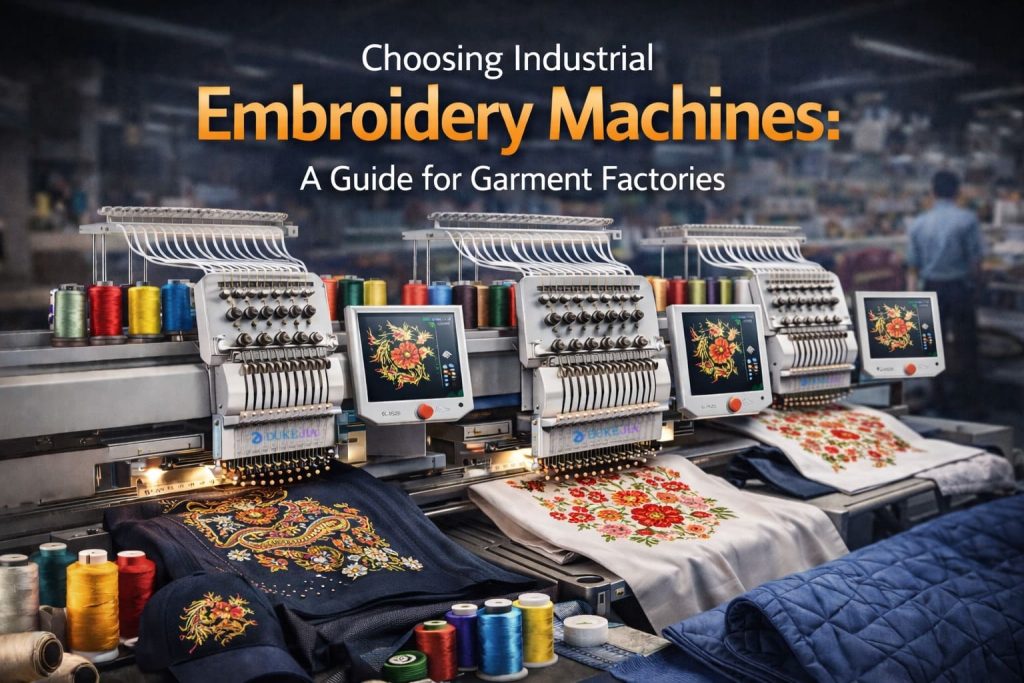
In today’s competitive garment manufacturing landscape, value-addition is no longer a luxury but a necessity for enhancing product appeal, brand identity, and ultimately, profit margins. Industrial embroidery machines stand at the forefront of this value-addition strategy, transforming ordinary garments into bespoke items with intricate designs, logos, and embellishments. The setup in the image illustrates how a modern industrial embroidery solution fits into a value-addition line, bringing precision and efficiency to the production floor.
DukeJia, represented in India by Hari Chand Anand & Co. (HCA), is a trusted value-addition machinery partner for garment factories, supplying and servicing industrial embroidery, perforation, and quilting machines across India, including major hubs like Delhi NCR, Tirupur, Ludhiana, Chennai, and Bengaluru. This guide is designed to assist garment factory owners, production managers, industrial engineers, and maintenance teams in making informed decisions when choosing industrial embroidery machines for garment factories.
Why Industrial Embroidery is Crucial for Modern Garment Factories
Industrial embroidery machines are versatile workhorses, finding application across a vast array of products:
- Apparel: T-shirts, polos, hoodies, jackets, denim, activewear, children’s wear.
- Uniforms: Corporate wear, school uniforms, hospital scrubs, hospitality attire.
- Sportswear: Team jerseys, caps, branded athletic wear, where durability and detail are key.
- Home Textiles: Towels, bed linens, curtains, upholstery, adding decorative elements.
- Accessories: Bags, caps, patches, footwear components.
By integrating embroidery, factories can solve several critical shop floor challenges, directly impacting quality, speed, operator comfort, power consumption, running cost, and overall value.
The Mechanics of Industrial Embroidery: A Closer Look
At its core, an industrial embroidery machine creates designs by repeatedly forming stitches using multiple needles and threads, guided by a computerized pattern.
Working Principle
The machine operates on a lock stitch principle, similar to a sewing machine, but with added complexity for intricate designs. A needle carries the upper thread through the fabric, forming a loop on the underside. A rotary hook then catches this loop, passes it around a bobbin thread, and forms a secure lock stitch. This process is repeated thousands of times per minute. Simultaneously, a pantograph mechanism precisely moves the hooped fabric (or garment) along X and Y axes according to the digitized design data, ensuring accurate placement of each stitch.
Key Components and Their Role
- Needle Bar Assembly: Houses multiple needles, each dedicated to a specific thread color. Modern machines feature automatic color change.
- Rotary Hooks & Bobbins: Located beneath the needle plate, these form the lower part of the lock stitch.
- Pantograph/Frame Drive: The precision mechanism that moves the embroidery frame (holding the fabric) in X and Y directions. High-precision servo motors ensure smooth, accurate movement.
- Control Panel: The brain of the machine, featuring a user-friendly interface for loading designs, setting parameters, and monitoring progress.
- Thread Tensioners: Crucial for maintaining consistent upper thread tension for uniform stitch quality.
- Automatic Trimmers: Cut both upper and bobbin threads between color changes or design elements, reducing manual intervention and improving efficiency.
Typical Production Capacities
Industrial embroidery machines are characterized by their number of heads (typically 1 to 20 or more) and speed. Each head can operate independently or in sync. A typical head speed ranges from 600 to 1200 stitches per minute (SPM), depending on the design complexity and machine model. This means a multi-head machine can produce multiple identical embroidered pieces simultaneously, drastically increasing output.
Solving Shop Floor Challenges with Modern Embroidery
Modern industrial embroidery machines are engineered to tackle common production bottlenecks:
- Quality & Consistency: Computerized control ensures perfect replication of designs, eliminating human error and maintaining consistent stitch quality across batches.
- Speed & Efficiency: Multi-head systems, high RPM, automatic thread trimming, and fast color changes significantly boost output. Quick-change hooping systems minimize downtime between operations.
- Operator Comfort & Skill: Intuitive touchscreen interfaces and automated functions reduce the need for highly specialized operators, making the machines easier to learn and operate.
- Power Consumption & Running Cost: Energy-efficient servo motors, LED lighting, and optimized machine designs contribute to lower electricity bills. Reduced thread breakage and automatic trimming minimize material waste.
- Value Addition & Better Margins: The ability to produce complex, high-quality embroidery directly translates to higher perceived value for the product, enabling better FOB (Free On Board) pricing and improved profit margins. Customization options open new markets and branding opportunities.
Types of Industrial Embroidery Machines: Making the Right Choice
Choosing the right machine involves understanding the available options and aligning them with your factory’s specific needs.
| Feature/Category | Mechanical/Older Generation Machines | Modern, Fully Computer-Controlled Machines |
|---|---|---|
| Control System | Manual adjustments, limited pattern memory, mechanical levers. | Advanced CPU, touch screen interface, vast pattern memory, networkable. |
| Automation | Manual trimming, color change, limited sensors. | Auto trimming, auto color change, thread break detection, design editing. |
| Speed & Efficiency | Slower, more manual intervention, higher downtime. | High-speed, continuous operation, minimal manual intervention. |
| Precision | Can be good, but susceptible to manual inconsistencies. | Digital precision, highly repeatable stitch quality. |
| Versatility | Limited design changes, fixed parameters. | Easy design scaling, rotation, mirroring, wide range of applications. |
| Maintenance | More mechanical parts, frequent manual adjustments. | Less frequent mechanical issues, but requires specialized electronics. |
| Connectivity | Standalone operation. | USB, LAN, remote monitoring, design software integration. |
| Cost | Lower initial investment, but higher running costs due to inefficiency. | Higher initial investment, but lower running costs and higher output. |
Japanese/European vs. Chinese/Other Asian Machines
- Japanese/European (e.g., Barudan, Tajima, ZSK): Known for superior build quality, exceptional longevity, very high precision, and advanced proprietary features. They often come with a higher initial price tag but offer unmatched reliability and resale value over decades.
- Chinese/Other Asian (e.g., DukeJia): Offer highly competitive pricing with rapidly improving quality and feature sets. These machines provide excellent value for money, often incorporating many advanced features found in premium brands at a more accessible price point. They are ideal for factories looking for robust, feature-rich machines that deliver strong ROI without the top-tier capital expenditure. DukeJia machines are a prime example, combining advanced features with competitive pricing and strong after-sales support through HCA.
When Higher Automation is Justified
- Multi-Head Machines: Essential for mass production of identical designs (e.g., uniforms, branded merchandise, high-volume apparel).
- Automatic Thread Trimming & Color Change: A non-negotiable for efficiency, reducing operator fatigue and increasing overall speed.
- Thread Break Detection: Minimizes downtime and ensures consistent quality by automatically stopping the machine if a thread breaks.
- Large Pattern Memory & Networking: Crucial for factories managing a diverse range of designs and integrating with design and production planning software.
- Special Attachments: Cording, sequin, boring devices are justified when specific design elements are frequently required for higher value-addition.
For factories with small runs, sampling needs, or highly specialized, non-repetitive designs, a basic single-head machine might suffice, but for any serious industrial production, modern multi-head, automated systems are the standard.
Maintenance and Daily Care for Optimal Performance
Regular maintenance is paramount to extend the lifespan of your industrial embroidery machine and ensure consistent stitch quality.
- Needles: Always use the correct needle type (e.g., sharp point for wovens, ballpoint for knits) and size for your fabric and thread. Replace needles regularly (e.g., every 8-10 hours of operation or at the first sign of damage/skipped stitches).
- Thread Path Inspection: Ensure the thread path is clear of lint, burrs, or obstructions. Inspect tension discs for cleanliness and proper function.
- Cleaning: Daily removal of lint and dust from the rotary hook area, thread tension discs, needle bar, and pantograph guides. Compressed air can be useful, but use caution.
- Lubrication: Follow the manufacturer’s oiling schedule meticulously. Proper lubrication of the rotary hook, needle bar drive, and other moving parts is crucial for smooth operation and preventing wear.
- Calibration & Service: Schedule periodic preventive maintenance by qualified technicians (like those from HCA) to check timing, tension, head alignment, and software updates.
- Genuine Spares: Always use genuine spare parts. DukeJia, through HCA, ensures the availability of authentic spares for all its machines, crucial for long-term reliability.
Troubleshooting Common Embroidery Machine Issues
Even with the best maintenance, issues can arise. Here’s a quick guide to common problems:
- Skipped Stitches:
- Likely Causes: Worn or bent needle, incorrect needle size/type, improper threading, incorrect thread tension, hooping too loose or tight, timing issues.
- Basic Solutions: Replace needle, re-thread, adjust tension, re-hoop firmly, clean rotary hook area. If persistent, call service.
- Thread Breakage:
- Likely Causes: Poor quality thread, incorrect threading, excessive tension, burrs in thread path (needle eye, tension discs), worn needle, bobbin case issues.
- Basic Solutions: Check thread quality, re-thread carefully, adjust tension, inspect thread path for obstructions, replace needle.
- Looped or Puffy Stitches:
- Likely Causes: Upper thread tension too loose, bobbin tension incorrect, fabric not properly stabilized.
- Basic Solutions: Tighten upper thread tension, adjust bobbin tension, ensure fabric is hooped securely with appropriate backing.
- Distorted Designs:
- Likely Causes: Improper hooping (fabric slipping), design too dense for fabric/backing, machine vibration, pantograph malfunction.
- Basic Solutions: Re-hoop fabric with correct tension and backing, ensure stable machine setup. Review design density if repeatedly an issue on certain fabrics.
DukeJia & HCA: Your Partner in Value-Addition Machinery
DukeJia, represented by Hari Chand Anand & Co. (HCA), is committed to empowering Indian garment factories with cutting-edge value-addition solutions. We don’t just supply machines; we offer a complete partnership. Our product portfolio includes advanced industrial embroidery machines, precision perforation/laser cutting systems for sportswear and intricate design details, and high-efficiency quilting machines for jackets, home textiles, and padded products.
We provide solutions for a wide range of applications: precise logo and placement embroidery, all-over quilting for blankets and jackets, intricate sportswear perforation patterns, creative appliqué work, and large-scale home textile quilting.
Our commitment extends far beyond the sale. HCA’s comprehensive after-sales support includes:
- Professional Installation: Ensuring optimal setup and performance from day one.
- Operator Training: Equipping your team with the skills to maximize machine efficiency and quality.
- Preventive Maintenance Programs: Proactive care to minimize downtime and extend machine life.
- Genuine Spares Availability: Readily available authentic parts to ensure sustained performance.
- Responsive On-Call Service Teams: Strategically located in major textile hubs like Delhi NCR, Tirupur, Ludhiana, Chennai, and Bengaluru, ensuring quick resolution of any technical issues.
Industrial Embroidery Machine Selection Checklist
Before making your investment, consider these key points:
- Production Volume & Design Complexity: How many pieces do you need to produce daily? How intricate are your typical designs?
- Fabric Types: What fabrics will you be embroidering most frequently (knits, wovens, heavy denim, delicate silks)?
- Budget: What is your initial investment capacity? Factor in running costs (power, consumables, maintenance).
- Automation Level Required: Do you need multi-heads, auto-trimmers, color change, thread break detection, or specialized attachments?
- Space Availability: How much floor space can you allocate for the machine and its peripherals?
- After-Sales Service & Spares Availability: Crucial for long-term peace of mind. Ensure reliable support and genuine parts are accessible.
- Operator Skill Level: How much training will your operators require? Look for user-friendly interfaces.
- Future Expansion Plans: Choose a machine that can scale with your business or integrate into a larger production system.
Frequently Asked Questions
What types of garments can be embroidered with industrial machines?
Industrial embroidery machines are highly versatile and can embroider a wide range of products including apparel (T-shirts, hoodies, denim, activewear), uniforms (corporate, school, hospital), sportswear (jerseys, caps), home textiles (towels, linens), and various accessories like bags and patches.
What are the main benefits of investing in modern industrial embroidery machines?
Modern machines offer superior quality and consistency through computerized control, high speed and efficiency with multi-head systems and automation, reduced power consumption, and lower running costs. Most importantly, they significantly enhance value addition to products, allowing for better margins and brand appeal.
How do DukeJia embroidery machines compare to Japanese/European brands?
While Japanese/European brands like Barudan and Tajima are renowned for premium build and longevity, DukeJia machines offer highly competitive pricing with rapidly improving quality and feature sets. They provide excellent value for money, incorporating advanced features at a more accessible price point, backed by strong after-sales support from HCA in India.
What kind of after-sales support does HCA provide for DukeJia machines?
HCA provides comprehensive after-sales support including professional installation, operator training, preventive maintenance programs, readily available genuine spares, and responsive on-call service teams strategically located in major textile hubs across India.
How often should needles be replaced on an industrial embroidery machine?
It is recommended to replace needles regularly, typically every 8-10 hours of operation, or immediately at the first sign of damage, dullness, or skipped stitches to maintain optimal stitch quality and prevent fabric damage.
What are common causes of thread breakage and how can they be resolved?
Common causes include poor quality thread, incorrect threading, excessive tension, burrs in the thread path (needle eye, tension discs), and worn needles. Solutions involve checking thread quality, re-threading carefully, adjusting tension, inspecting the thread path for obstructions, and replacing worn needles.
Is higher automation always necessary for embroidery machines?
For serious industrial production, modern multi-head, automated systems are standard due to their efficiency. However, for small runs, sampling needs, or highly specialized, non-repetitive designs, a basic single-head machine might suffice, depending on the factory’s specific requirements and production volume.
For DukeJia embroidery, perforation or quilting machine demonstrations, pricing or technical consultation, contact Hari Chand Anand & Co. (HCA), New Delhi.