
Published on: 02 Mar 2026
Using Embroidery Machines for Uniforms: Adding Value & Efficiency in Garment Manufacturing
Key takeaways for garment factories:
- Industrial embroidery machines significantly enhance the value and brand appeal of school and corporate uniforms.
- Modern multi-head, computerized machines offer superior precision, speed, and automation compared to older models.
- They solve common production challenges like durability, consistency, and professional aesthetics, directly supporting higher FOB prices.
- Choosing the right machine involves balancing production needs with investment, with brands like DukeJia offering a strong balance of features and value.
- Regular maintenance and basic troubleshooting are vital for maximizing machine uptime and extending lifespan.
Table of Contents
- Using Embroidery to Add Value in School and Corporate Uniforms
- The Mechanics of Modern Industrial Embroidery
- Operational Advantages and Shop Floor Impact
- Choosing the Right Industrial Embroidery Machine
- Essential Maintenance for Optimal Performance
- Common Troubleshooting for Embroidery Machines
- Key Takeaways
- Frequently Asked Questions
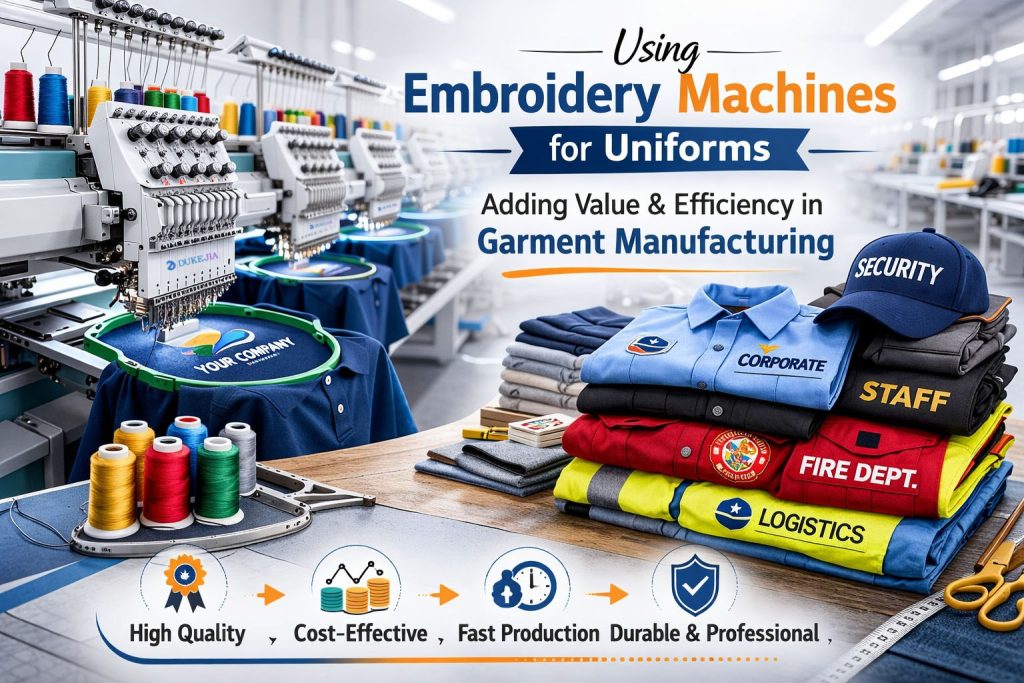
The garment industry thrives on value addition, and for factories specializing in school and corporate uniforms, industrial embroidery machines are indispensable. These machines transform basic apparel into branded, professional, and durable wear, significantly enhancing their market appeal and profitability. The setup in the image illustrates how a modern industrial embroidery solution fits into a value-addition line within a garment factory, showcasing precision and efficiency in action.
Using Embroidery to Add Value in School and Corporate Uniforms
In the competitive uniform market, differentiation is key. School and corporate uniforms are more than just clothing; they are powerful tools for branding, identity, and instilling a sense of belonging. Embroidery offers a permanent, high-quality method to integrate logos, emblems, and individual names, providing a premium finish that screen printing or heat transfers often cannot match. This elevates the perceived value of the uniform, directly supporting higher FOB (Free on Board) prices or better margins for garment manufacturers.
Garment factories utilize industrial embroidery machines extensively for:
- Corporate Wear: Polo shirts, formal shirts, blazers, caps, and workwear with company logos.
- School Uniforms: Crests on shirts, blazers, sweaters, and sportswear.
- Sports Teams: Logos and numbering on jerseys and tracksuits.
- Hospitality & Healthcare: Monograms and branding on staff uniforms.
Embroidery helps solve common production challenges by offering consistent quality, durability against repeated washing, and a professional aesthetic that is critical for brand representation.
The Mechanics of Modern Industrial Embroidery
At its core, industrial embroidery involves stitching a design onto fabric using multiple needles and threads, guided by a computerized program. Modern machines are multi-head systems, meaning several embroidery heads work simultaneously on different garments or sections of a single garment, maximizing output.
Working Principle:
- Digitization: A design (logo, text) is converted into a stitch file (.DST, .EXP, etc.) using specialized software. This file contains instructions for each stitch’s location, color, and type.
- Hooping: The fabric is securely clamped into an embroidery hoop, which holds it taut and allows for precise movement under the needle.
- Stitch Formation: Each head operates like a sophisticated sewing machine. A needle penetrates the fabric, carrying the top thread. Below the fabric, a rotary hook catches the needle thread, wrapping it around a bobbin thread to form a secure lockstitch.
- Automated Movement: Servo or stepper motors precisely control the movement of the embroidery hoop (X-Y axis) and the needle bar (Z-axis), following the digitized pattern. Automatic thread trimmers cut threads between color changes or design elements, ensuring a clean finish.
Key Components and Their Role:
- Needle Bar System: Holds multiple needles, allowing for quick color changes.
- Thread Tensioners: Precisely control the tension of each thread for consistent stitch quality.
- Rotary Hook System: Forms the lockstitch with the bobbin thread.
- Pantograph/Hoop Drive: Moves the frame holding the hooped fabric in X and Y directions.
- Main Shaft & Motors: Drive the needle bars and pantograph movement, often using quiet and efficient servo motors.
- Control Panel: The human-machine interface (HMI) for loading designs, setting parameters, and monitoring the process.
- Automatic Trimmers: Cut threads automatically, reducing manual intervention.
Operational Advantages and Shop Floor Impact
Integrating modern industrial embroidery machines offers significant benefits across the garment factory floor:
Quality & Consistency:
- Precision: Computer-controlled movement ensures exact replication of designs, critical for brand consistency across thousands of uniforms.
- Durability: High-density stitching and robust thread ensure logos withstand repeated washing and wear, addressing a key quality concern for uniforms.
Speed & Efficiency:
- Multi-head Production: Machines with 6, 12, 18 or more heads dramatically increase throughput. A typical head can achieve speeds of 800-1200 stitches per minute (SPM), depending on the design and machine model.
- Automation: Automatic color changes, thread trimming, and pattern memory reduce downtime and operator involvement, enabling continuous production.
- Operator Comfort: User-friendly interfaces and automated functions reduce physical strain and the need for highly specialized manual skills, allowing operators to manage multiple heads efficiently.
Running Costs & Value Addition:
- Power Consumption: Modern machines often use energy-efficient servo motors, reducing electricity costs compared to older models.
- Material Efficiency: Precise stitching and tension control minimize thread breakage and wastage.
- Higher Margins: The premium finish and durability of embroidered uniforms command higher prices, directly contributing to better FOB values and overall factory profitability.
Choosing the Right Industrial Embroidery Machine
Selecting the appropriate machine involves weighing initial investment against long-term operational benefits.
Modern Computerized vs. Older Mechanical Machines:
| Feature | Modern Computerized Multi-Head Machine | Older Mechanical/Semi-Mechanical Machine |
|---|---|---|
| Precision | High, digital control for exact replication | Moderate, dependent on mechanical linkages, prone to wear |
| Speed | High (800-1200+ SPM per head), multi-head operation | Lower (e.g., 400-600 SPM), often single-head or limited multi-head |
| Automation | Auto trimming, auto color change, pattern memory, error detection | Manual trimming, manual color change, limited pattern memory |
| Ease of Use | User-friendly interface, less operator skill required | Requires skilled operator for setup and adjustments |
| Versatility | Wide range of fabrics and design complexities, varied hoop sizes | More limited in fabric and design complexity |
| Maintenance | Software updates, routine cleaning, specialized technician for electronics | Mechanical adjustments, lubrication, parts replacement |
| Initial Cost | Higher | Lower |
| Running Cost | Lower (efficiency, reduced waste, power savings) | Higher (labor, downtime, material waste) |
Chinese/Other Asian vs. Japanese/European Machines:
While Japanese and European machines are known for exceptional build quality, longevity, and often higher speeds, modern Chinese and other Asian manufacturers (like DukeJia) offer robust, feature-rich machines that provide an excellent balance of performance, reliability, and competitive pricing. They are designed for high production environments, offering significant ROI for garment factories looking for advanced automation without the premium price tag of some Western brands. When higher automation (multi-head systems, automatic trimming, extensive pattern memory) is justified by high volume, complex designs, and a need for minimal operator intervention, modern programmable models are always the superior choice. Basic, single-head models might suffice for very low-volume, specialized applications, but for uniform production, multi-head systems are essential.
Buying Guide / Selection Checklist:
- Number of Heads & Needles: Match production volume and design complexity.
- Embroidery Field Size: Ensure adequate space for large logos or multiple small ones per hoop.
- Speed (SPM): Look for optimal speeds without compromising stitch quality.
- Automation Features: Auto trimming, color change, thread break detection, networking capabilities.
- Software Compatibility: Ease of integrating with existing design software.
- Frame/Hoop Options: Versatility for different garment types (caps, pockets, flat goods).
- After-Sales Support: Critical for uptime and longevity.
Essential Maintenance for Optimal Performance
Regular maintenance is paramount to ensure the longevity and consistent performance of industrial embroidery machines.
Daily Care:
- Needle Inspection: Replace bent or dull needles immediately to prevent thread breakage and fabric damage.
- Thread Path Cleaning: Remove lint and thread residue from tension discs, thread guides, and eyelets.
- Rotary Hook Cleaning & Oiling: Regularly clean lint from the bobbin case area and apply a drop of high-quality oil to the rotary hook.
- General Cleaning: Wipe down the machine to remove dust and fabric particles.
Weekly/Monthly Checks:
- Lubrication: Follow manufacturer guidelines for oiling specific moving parts.
- Tension Calibration: Check and adjust thread tensions for all needles.
- Belt Tension: Ensure drive belts are at proper tension.
- Software Backup: Back up design files and machine settings.
Preventive maintenance schedules, often provided by the supplier, are crucial for long-term operational efficiency and to avoid unexpected breakdowns.
Common Troubleshooting for Embroidery Machines
Even with the best machines, minor issues can arise. Here’s a quick guide to common faults:
- Thread Breakage:
- Causes: Incorrect tension, burrs on needle/thread path, poor quality thread, worn needle, incorrect needle size for fabric, timing issues.
- Basic Solutions: Re-thread the machine, check tensions, replace needle, clean thread path, use quality thread.
- Skipped Stitches:
- Causes: Bent or dull needle, incorrect needle insertion, poor hooping, machine timing issues.
- Basic Solutions: Replace needle, ensure needle is correctly oriented, re-hoop fabric tightly.
- Poor Registration (Design Misalignment):
- Causes: Loose hooping, fabric shifting, worn pantograph belts, software issues.
- Basic Solutions: Ensure tight hooping, check machine’s physical alignment, verify design data.
- Unusual Noise:
- Causes: Lack of lubrication, loose components, foreign object in mechanism.
- Basic Solutions: Lubricate as per manual, check for loose screws, inspect for obstructions.
For complex issues, it’s always best to consult with a qualified service technician.
Key Takeaways
- Industrial embroidery machines significantly enhance the value and brand appeal of school and corporate uniforms.
- Modern multi-head, computerized machines offer superior precision, speed, and automation compared to older models.
- Key components like needle bars, rotary hooks, and automated trimmers ensure efficient stitch formation and clean finishes.
- Choosing the right machine involves balancing production needs with investment, with brands like DukeJia offering a strong balance of features and value.
- Regular maintenance and basic troubleshooting are vital for maximizing machine uptime and extending lifespan.
Frequently Asked Questions
Why should garment factories choose embroidery over other methods for uniform branding?
Embroidery offers a permanent, high-quality, and professional finish that elevates the perceived value of uniforms. Unlike screen printing or heat transfers, embroidery is highly durable against repeated washing and wear, ensuring brand consistency and a premium aesthetic crucial for corporate and school identities.
How do modern multi-head embroidery machines improve production efficiency?
Modern multi-head machines allow several garments or sections to be embroidered simultaneously, dramatically increasing throughput. Features like automatic color changes, thread trimming, and pattern memory reduce manual intervention and downtime, enabling continuous, high-speed production (800-1200+ SPM per head).
What are the essential daily maintenance tasks for an industrial embroidery machine?
Daily care includes inspecting and replacing bent/dull needles, cleaning lint and residue from the thread path, cleaning and oiling the rotary hook area, and general machine wiping. These tasks prevent thread breakage, fabric damage, and ensure consistent stitch quality.
What factors should be considered when choosing between different brands of industrial embroidery machines?
Key factors include the number of heads and needles, embroidery field size, speed (SPM), automation features (auto trimming, color change), software compatibility, frame/hoop options, and crucially, after-sales support. While Japanese/European machines are premium, brands like DukeJia offer robust, feature-rich machines with excellent performance, reliability, and competitive pricing for high production environments.
What typically causes thread breakage during embroidery, and how can it be resolved?
Common causes include incorrect thread tension, burrs on the needle or thread path, poor quality thread, a worn or incorrect needle size, and timing issues. Basic solutions involve re-threading, checking and adjusting tensions, replacing the needle, cleaning the thread path, and ensuring the use of high-quality embroidery thread.
Does DukeJia provide training and support for their embroidery machines?
Yes, DukeJia, through Hari Chand Anand & Co. (HCA) in India, offers comprehensive after-sales support. This includes professional installation, in-depth operator and technician training, tailored preventive maintenance schedules, readily available genuine spare parts, and responsive on-call service teams across major hubs like Delhi NCR, Tirupur, and Bengaluru.
For DukeJia embroidery, perforation or quilting machine demonstrations, pricing or technical consultation, contact Hari Chand Anand & Co. (HCA), New Delhi.