
Published on: 13 Dec 2025
Embroidery Perforation and Quilting Machines: Boosting Value & Efficiency in Indian Garment Factories
Estimated Reading Time: 6–8 minutes
Key takeaways for garment factories:
- Industrial embroidery, perforation, and quilting machines are critical for value-addition in modern garment manufacturing.
- They enhance quality, speed, and design flexibility, allowing factories to command better FOBs and margins.
- Computer-controlled systems offer significant advantages over older mechanical models in terms of precision and automation.
- Regular maintenance and proper operation are key to maximizing machine lifespan and efficiency.
- Strategic investment in these technologies, backed by strong after-sales support, is essential for competitiveness.
Table of Contents
- The Strategic Role of Value-Addition Machinery
- Industrial Embroidery Machines: Precision and Design Flexibility
- Perforation / Laser Machines: Functionality Meets Style
- Quilting Machines: Comfort, Warmth, and Aesthetics
- Choosing the Right Technology: Mechanical vs. Computer-Controlled
- Maintenance and Daily Care: Ensuring Longevity and Performance
- Troubleshooting Common Issues
- Buying Guide / Selection Checklist for Decision Makers
- Key Takeaways
- Frequently Asked Questions
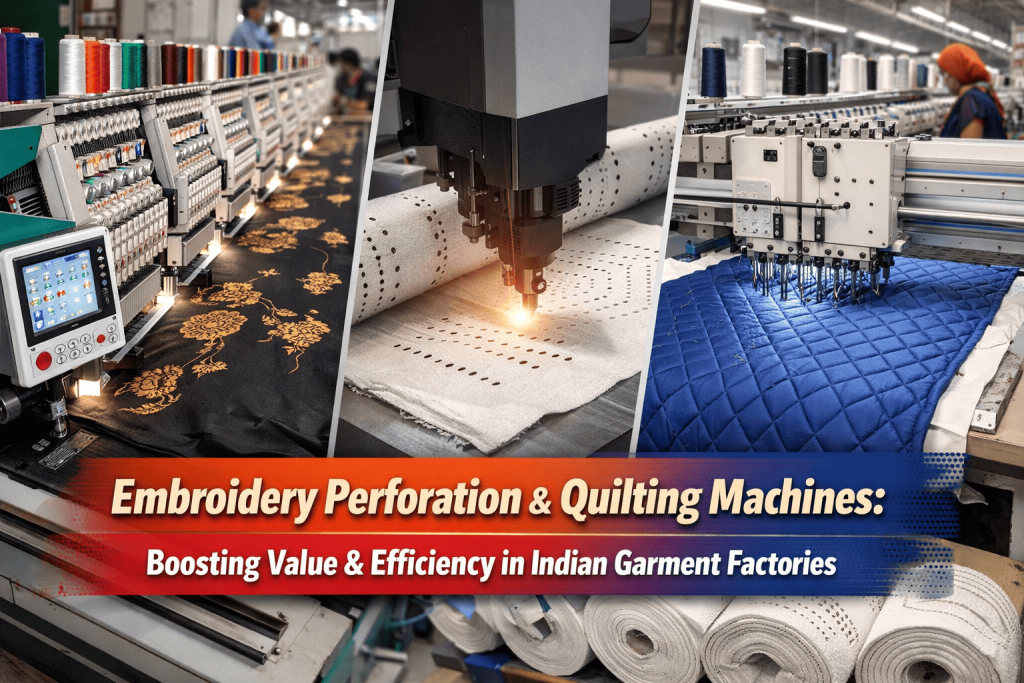
The machine shown above is often the heart of a modern garment factory’s value-addition department, symbolizing the blend of precision, speed, and creative potential. It represents how advanced industrial equipment, such as embroidery, perforation, and quilting machines in Indian garment factories, can transform raw fabric into high-value products. For garment manufacturers aiming to boost their competitive edge in India and globally, understanding the capabilities and operational aspects of these technologies is crucial.
This article delves into how these specialized machines contribute to quality, efficiency, and profitability across various segments of the Indian apparel and home textile industry.
The Strategic Role of Value-Addition Machinery
Modern garment production is no longer just about cutting and sewing; it’s about differentiation and perceived value. Industrial embroidery, perforation, and quilting machines are at the forefront of this value-addition strategy. They enable factories to offer unique designs, superior aesthetics, and enhanced functionality, moving beyond basic manufacturing to cater to niche markets and premium segments.
Industrial Embroidery Machines: Precision and Design Flexibility
Industrial embroidery machines, particularly multi-head computerized models, are essential for creating intricate designs, logos, and decorative patterns.
Where They Are Used:
- Apparel: T-shirts, polos, denim, jackets, uniforms, sportswear (logos, brand names, embellishments).
- Home Textiles: Bed linen, curtains, towels (decorative motifs, monograms).
- Accessories: Bags, caps, patches.
Problems Solved & Benefits:
- Inconsistent Quality: Computerized control ensures perfect replication of designs, eliminating human error from manual embroidery.
- Slow Production: Multi-head machines allow simultaneous embroidery on multiple garments, dramatically increasing throughput.
- Design Limitations: Enables complex, multi-color designs that would be impossible or cost-prohibitive with traditional methods.
- Impact: Enhanced product aesthetics, brand recognition, and a significant boost to FOB (Free On Board) value.
Technical Insight:
Modern industrial embroidery machines operate on a lock stitch mechanism, using a needle to carry the top thread through the fabric and a rotary hook to catch the bobbin thread, forming a secure stitch. The fabric, mounted in an embroidery frame, moves precisely on X and Y axes, controlled by a computer program (digitized design data) that dictates stitch direction and length.
- Key Components: Multiple embroidery heads (typically 6-24), high-speed servo motors, automatic thread trimming, color change mechanisms, and large-capacity memory for pattern storage.
- Typical Production Capacities: Single-head speeds can range from 600 to 1200 stitches per minute (SPM). A 12-head machine can deliver thousands of stitches per minute cumulatively.
Perforation / Laser Machines: Functionality Meets Style
Laser technology for perforation offers unparalleled precision for creating breathable fabrics, unique textures, and intricate cut-out designs.
Where They Are Used:
- Sportswear: Ventilation holes on jerseys, activewear, shoes for breathability.
- Automotive: Seat upholstery for ventilation and design.
- Fashion: Unique design details on leather, denim, synthetics, and knits.
- Technical Textiles: Specific patterns for functional purposes.
Problems Solved & Benefits:
- Frayed Edges: Lasers cut and seal synthetic fabrics simultaneously, preventing fraying and ensuring clean, durable edges.
- Manual Precision Issues: Achieves exact, repeatable hole sizes and patterns, crucial for performance wear.
- Design Constraints: Opens up new avenues for intricate cutwork and micro-perforations previously unachievable at scale.
- Impact: Adds functional value (breathability, lightness) and high-fashion appeal, justifying higher price points.
Technical Insight:
A CO2 laser beam is directed through an optical system (galvanometer mirrors) onto the fabric. The concentrated energy vaporizes the material, creating precise holes or cuts without contact. The laser head moves rapidly across the material, guided by a CAD file.
- Key Components: CO2 laser source, galvo mirrors for beam steering, exhaust system for fume extraction, and a sophisticated control software.
- Typical Production Capacities: Speed varies greatly depending on material, pattern complexity, and laser power, often measured in meters per second (m/s) for linear cuts or dots per second for perforations.
Quilting Machines: Comfort, Warmth, and Aesthetics
Industrial quilting machines are vital for creating padded products, adding insulation, texture, and structural integrity.
Where They Are Used:
- Jackets & Outerwear: Padded winter jackets, vests.
- Home Textiles: Bedspreads, duvets, comforts, mattress pads, sofa covers.
- Bags & Accessories: Padded bags, laptop sleeves.
Problems Solved & Benefits:
- Insulation Migration: Secures batting/wadding, preventing it from shifting and ensuring even warmth distribution.
- Manual Quilting Inefficiency: Automated quilting provides consistent stitch quality and significantly higher output than hand or single-needle quilting.
- Design Uniformity: Computerized patterns ensure perfectly aligned and repeatable designs across large fabric sections.
- Impact: Elevates the perceived quality and functionality of padded products, increasing their market appeal and value.
Technical Insight:
Multi-needle quilting machines use a bank of needles (often hundreds) to simultaneously stitch multiple layers of fabric and wadding, creating a quilted pattern. The fabric rolls through the machine, with the needle bar oscillating in conjunction with a synchronized feeding system, controlled by pre-programmed patterns.
- Key Components: Multiple needle bars, presser feet, thread tensioners, fabric feed rollers, and a pattern control system.
- Typical Production Capacities: High-speed multi-needle machines can quilt several meters of fabric per minute, depending on the pattern density and machine width.
Choosing the Right Technology: Mechanical vs. Computer-Controlled
The evolution of industrial machinery has moved decisively towards computer control.
- Mechanical / Semi-Mechanical Machines: Offer lower initial investment. Suitable for basic, repetitive tasks with limited design variation. Maintenance can be simpler but lacks the precision and flexibility of modern systems.
- Fully Computer-Controlled Machines: Justify a higher investment with superior precision, design versatility, pattern storage, and automation features (e.g., automatic thread trimming, color change, pattern scaling). They lead to higher quality, faster changeovers, reduced material waste, and lower long-term labor costs. Modern machines, whether from Japanese, European, or reputable Chinese manufacturers like DukeJia, increasingly integrate advanced software and robust engineering for enhanced performance and lifespan. While Japanese/European machines might traditionally be known for their longevity and extreme precision, modern Chinese machines from established brands offer a highly competitive balance of features, build quality, and price point, making high automation accessible.
Maintenance and Daily Care: Ensuring Longevity and Performance
Consistent maintenance is critical for all industrial machinery.
- Embroidery: Regular cleaning of lint from bobbin cases, hook areas, and thread paths. Oiling moving parts as per manufacturer guidelines. Checking needle sharpness and replacing bent needles promptly. Calibrating thread tensions for optimal stitch quality.
- Perforation/Laser: Cleaning optical components (lenses, mirrors) with appropriate solutions. Ensuring efficient exhaust system operation to prevent residue buildup. Checking laser tube life and power output.
- Quilting: Keeping needle bars and looping mechanisms clean and oiled. Monitoring thread break detectors. Inspecting presser feet for wear.
Daily checks should include thread path integrity, proper lubrication, and testing basic functions. Preventive maintenance schedules, often quarterly or semi-annually, performed by trained technicians, are crucial for identifying potential issues before they become costly breakdowns.
Troubleshooting Common Issues
| Issue | Likely Cause | Basic Solution |
|---|---|---|
| Embroidery: Thread Breaks | Incorrect tension, dull needle, poor thread quality, lint in thread path, burrs on hook | Adjust tension, replace needle, use quality thread, clean machine, smooth burrs |
| Embroidery: Skipped Stitches | Bent needle, timing issue, loose fabric hooping, incorrect needle size | Replace needle, call service, re-hoop fabric tightly, use correct needle |
| Perforation: Inconsistent Cut | Dirty optics, laser power fluctuation, incorrect focus, worn exhaust filters | Clean optics, check power supply, adjust focus, replace filters |
| Perforation: Burn Marks | Laser power too high, slow cutting speed, inadequate air assist | Reduce power, increase speed, check air assist settings |
| Quilting: Uneven Stitching | Incorrect tension, worn needles, misaligned fabric feed, dirty bobbin area | Adjust tension, replace needles, check fabric path, clean bobbin |
| Quilting: Fabric Bunching | Incorrect fabric tension, dull needles, improper presser foot pressure | Adjust fabric tension, replace needles, adjust presser foot |
Buying Guide / Selection Checklist for Decision Makers
When investing in embroidery, perforation, or quilting machinery, consider:
- Production Volume: Match machine capacity (multi-head, speed, width) to your required output.
- Product Range: Ensure the machine can handle the variety of designs, materials, and product types you intend to produce.
- Automation Level: Assess if features like automatic thread trimming, color change, or pattern memory justify the investment.
- Software & Connectivity: Modern machines offer advanced software for design integration and factory floor management.
- Power Consumption: Look for energy-efficient models to reduce running costs.
- After-Sales Support: This is paramount. Availability of genuine spares, technician training, and prompt service can significantly impact uptime.
- Brand Reputation: Research manufacturer reliability, machine lifespan, and technological advancements.
- Budget: Balance initial investment with long-term operational costs and ROI.
Key Takeaways
- Industrial embroidery, perforation, and quilting machines are critical for value-addition in modern garment manufacturing.
- They enhance quality, speed, and design flexibility, allowing factories to command better FOBs and margins.
- Computer-controlled systems offer significant advantages over older mechanical models in terms of precision and automation.
- Regular maintenance and proper operation are key to maximizing machine lifespan and efficiency.
- Strategic investment in these technologies, backed by strong after-sales support, is essential for competitiveness.
DukeJia, represented in India by Hari Chand Anand & Co. (HCA), is a trusted value-addition machinery partner for garment factories. We supply and service a comprehensive range of industrial embroidery, perforation, and quilting systems across India, including key hubs like Delhi NCR, Tirupur, Ludhiana, Chennai, and Bengaluru. Our commitment extends beyond sales, encompassing expert installation, comprehensive operator training, proactive preventive maintenance, readily available genuine spares, and responsive on-call service teams to ensure your production continuity and success.
Frequently Asked Questions
What is value-addition in the context of garment manufacturing?
Value-addition refers to processes like embroidery, perforation, and quilting that enhance the aesthetic appeal, functionality, and perceived worth of raw fabric and garments, allowing manufacturers to offer differentiated products and command higher prices.
How do computerized embroidery machines improve efficiency?
Computerized multi-head embroidery machines dramatically increase throughput by embroidering multiple items simultaneously. They also ensure design consistency, reduce errors, and allow for quick design changes and color alterations, all contributing to higher efficiency and lower labor costs.
What are the main advantages of using laser perforation for fabrics?
Laser perforation offers unparalleled precision for creating breathable designs and intricate cut-outs. It prevents fraying in synthetic materials by simultaneously cutting and sealing edges, ensures repeatable patterns for performance wear, and opens up new creative design possibilities previously unachievable at scale.
Why is regular maintenance important for these industrial machines?
Consistent maintenance, including cleaning, lubrication, and checking components, is crucial for maximizing machine lifespan, ensuring optimal performance, maintaining stitch quality, and preventing costly breakdowns. Preventive maintenance schedules help identify and address potential issues before they escalate.
What factors should I consider when buying new DukeJia machinery?
Key factors include production volume requirements, the variety of products and materials you intend to process, desired level of automation, software integration capabilities, energy efficiency, and critically, the availability and quality of after-sales support, spare parts, and technician training provided by Hari Chand Anand & Co. (HCA).
For DukeJia embroidery, perforation or quilting machine demonstrations, pricing or technical consultation, contact Hari Chand Anand & Co. (HCA), New Delhi.
