
Published on: 22 Dec 2025
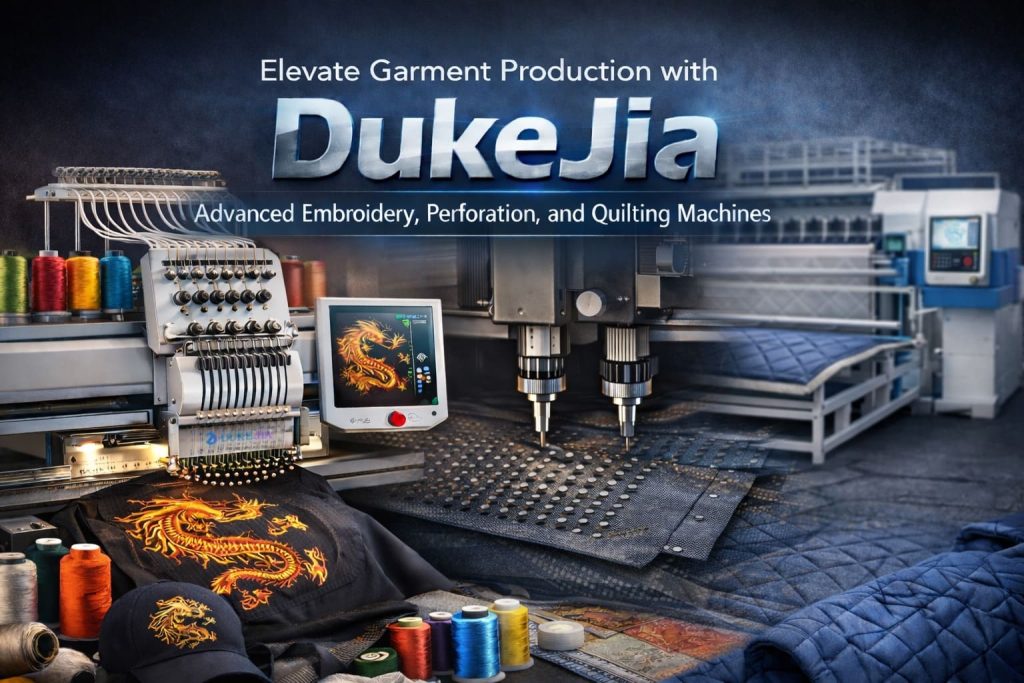
Elevate Garment Production with DukeJia: Advanced Embroidery, Perforation, and Quilting Machines
Key takeaways for garment factories:
- Value-Addition is Key: Industrial embroidery, perforation, and quilting machines are critical for elevating product quality, design, and market value.
- Efficiency & Quality: Modern computerized machines offer superior precision, speed, and consistency compared to older or manual methods.
- Strategic Investment: Choosing the right technology and level of automation impacts long-term profitability and competitive edge.
- Maintenance Matters: Regular care and genuine spares are crucial for machine longevity and consistent performance.
- Reliable Partnership: DukeJia, through Hari Chand Anand & Co., offers comprehensive solutions from machinery supply to after-sales support.
Table of Contents
- About DukeJia and Hari Chand Anand & Co.
- Elevating Garment Production with Advanced Machinery
- Choosing Your Technology: A Comparison and Selection Guide
- Maintenance and Daily Care Essentials
- Common Troubleshooting Guide
- Key Takeaways
- Your Partner for Value-Addition Machinery: DukeJia and HCA
- Frequently Asked Questions
About DukeJia and Hari Chand Anand & Co.
The garment manufacturing industry is a dynamic landscape, constantly evolving to meet consumer demands for quality, design, and efficiency. For factories aiming to elevate their product offerings and secure higher Free On Board (FOB) prices, investing in advanced value-addition machinery is no longer an option but a necessity. The setup in the image illustrates how a modern industrial machine integrates into a value-addition line, demonstrating precision and automation critical for today’s competitive environment. This article delves into the core offerings and expertise that DukeJia, represented in India by Hari Chand Anand & Co. (HCA), brings to garment factories across the nation.
DukeJia, in partnership with HCA, stands as a premier value-addition machinery partner, supplying and servicing cutting-edge industrial embroidery, perforation, and quilting machines across key manufacturing hubs including Delhi NCR, Tirupur, Ludhiana, Chennai, and Bengaluru. Our mission is to empower garment factories with the technology and support needed to enhance quality, optimize production, and expand design capabilities.
Elevating Garment Production with Advanced Machinery
For factory owners, production managers, and industrial engineers, understanding the capabilities and benefits of modern value-addition machinery is crucial. These machines are not just tools; they are strategic investments that solve common shop floor problems, reduce bottlenecks, and significantly contribute to a better bottom line.
Industrial Embroidery Machines: Precision and Design Versatility
Where it’s Used: Embroidery is ubiquitous, adorning T-shirts, polos, knitwear, jackets, denim, uniforms, caps, and home textiles like towels and bed linen. It’s essential for logos, branding, decorative motifs, appliqué, and intricate design details.
Technical Overview: Industrial embroidery machines, particularly multi-head computerized models, operate on a principle of synchronized needle movement and fabric framing. A digital design file (DST, EMB) controls the X-Y movement of the pantograph frame and the Z-axis movement of multiple needles simultaneously. Each head typically features multiple needles (e.g., 9, 12, 15) for quick color changes. Stitch formation involves the needle carrying the upper thread through the fabric, meeting a rotary hook beneath to pick up the bobbin thread, forming a lockstitch.
Factory Benefits:
- Quality & Consistency: Computerized control ensures uniform stitch density, tension, and placement across thousands of garments, crucial for brand consistency.
- Speed & Capacity: Multi-head machines drastically increase output compared to single-head or manual methods. Production capacities can range from 800-1200 stitches per minute (SPM) per head, depending on design complexity.
- Operator Comfort: Automation reduces manual intervention, improving ergonomics and allowing operators to manage multiple heads efficiently.
- Power Consumption & Running Cost: Modern servo motors are energy-efficient. Optimized thread paths, automatic trimming, and intelligent error detection reduce material waste and downtime.
Perforation / Laser Machines: Precision for Performance and Aesthetics
Where it’s Used: Laser perforation is vital for sportswear (ventilation, design elements), technical textiles, automotive interiors, footwear, and fashion garments requiring intricate cut-outs, etching, or controlled ventilation patterns.
Technical Overview: Laser machines utilize a focused high-power laser beam (CO2 or fiber) to precisely cut, engrave, or perforate materials. The design is loaded digitally, and the laser head moves over the fabric, controlled by a gantry system. The laser essentially vaporizes the material, creating clean, sealed edges without fraying. For perforation, controlled bursts create precise holes in specific patterns.
Factory Benefits:
- Quality & Precision: Unmatched accuracy for intricate patterns, small holes, and sharp edges, impossible with traditional cutting methods. No material distortion during processing.
- Speed & Efficiency: High-speed processing for complex designs, significantly faster than manual or die-cut methods for detailed work. Can process large areas quickly.
- Value-Addition: Enables unique designs and functional features (e.g., breathability in sportswear) that command higher FOBs and differentiate products.
- Problem Solved: Eliminates fraying issues common with mechanical cutting of synthetic fabrics and provides design flexibility for ventilation and aesthetics.
Quilting Machines: Crafting Comfort and Structure
Where it’s Used: Quilting is fundamental for jackets, outerwear, padded garments, home textiles (quilts, bedspreads, mattress toppers), and automotive seating. It adds insulation, texture, and structural integrity.
Technical Overview: Industrial quilting machines can range from single-needle to multi-needle computerized systems. Multi-needle shuttle or chain stitch machines simultaneously sew multiple parallel rows or intricate patterns across wide fabric rolls. The fabric, wadding/insulation, and backing material are fed in layers, and the machine’s programming controls the synchronized movement of the sewing heads and the material feed to create the desired pattern. Stitch formation is similar to conventional sewing, forming a secure lockstitch or chain stitch to hold the layers together.
Factory Benefits:
- Quality & Uniformity: Computerized quilting ensures consistent stitch length, pattern accuracy, and even distribution of insulation, critical for product performance and aesthetics.
- Speed & Output: Multi-needle machines can quilt entire fabric rolls at high speeds (e.g., 1000-1500 RPM per needle), drastically increasing production capacity for large runs.
- Design Flexibility: Modern machines can store hundreds of patterns, allowing for quick changes and complex designs to cater to diverse product lines.
- Cost Efficiency: Reduces labor requirements compared to manual quilting and minimizes material waste through precise pattern alignment.
Choosing Your Technology: A Comparison and Selection Guide
The choice of machinery significantly impacts a factory’s long-term performance and profitability. Here’s a comparative look and a checklist for decision-makers:
| Feature | Japanese / European Machines | Chinese / Other Asian Machines |
|---|---|---|
| Build Quality | Superior, robust engineering, long lifespan | Good to very good, improving rapidly |
| Life Expectancy | 15+ years with proper maintenance | 7-12 years with proper maintenance |
| Speed/Output | Often slightly higher top speeds, consistent | High speeds, sometimes optimized for specific tasks |
| Precision | Exceptionally high, fine detail capability | Very good, suitable for most industrial demands |
| Technology | Cutting-edge R&D, advanced features | Rapid adoption of new tech, cost-effective innovation |
| Price Point | Premium investment | Highly competitive, excellent value for money |
| Automation | High, often integrated with upstream/downstream | Increasingly high, user-friendly controls |
| Spares | Genuine parts available, sometimes higher cost | Readily available, cost-effective |
When is higher automation (multi-head, automatic trimming, pattern memory) justified?
When dealing with high volumes, complex designs, frequent design changes, or a need for superior consistency and reduced labor costs. For specialized, high-value products or large-scale production, automation quickly pays for itself.
When are basic models sufficient?
For smaller factories, niche production with stable designs, or initial entry into a new value-addition area where budget is a primary concern. Basic models offer core functionality at a lower investment.
Older Generation vs. Modern, Programmable Models:
Modern programmable models offer superior control, memory for hundreds of designs, faster setup times, reduced material waste, energy efficiency, and remote diagnostics capabilities. While older mechanical machines might be cheaper upfront, the operational efficiencies, quality improvements, and expanded design possibilities of modern computer-controlled systems far outweigh the initial investment in the long run.
Maintenance and Daily Care Essentials
Proper maintenance is the cornerstone of machine longevity and consistent performance.
- Daily Checks: Clean the machine (lint, dust, thread bits), check needle condition (replace bent/blunt needles), verify thread path, oil moving parts as per manufacturer guidelines, inspect bobbin/hook area.
- Weekly/Monthly: Clean tension discs, check belts for wear, lubricate major components, calibrate settings (tension, pressure feet) if needed.
- Preventive Maintenance: Schedule regular check-ups by qualified technicians. This proactive approach identifies potential issues before they cause costly downtime.
- Genuine Spares: Always use genuine spare parts recommended by the manufacturer to ensure compatibility, optimal performance, and machine lifespan. DukeJia/HCA ensures access to genuine spares for all supplied machines.
Common Troubleshooting Guide
| Fault Description | Likely Cause(s) | Basic Solution(s) |
|---|---|---|
| Embroidery: Thread breaks frequently | Incorrect tension, worn needle, poor thread quality, lint in path, wrong needle size | Adjust tension, replace needle, use quality thread, clean thread path, use correct needle |
| Embroidery: Skipped stitches | Bent needle, wrong needle point, incorrect timing, poor fabric hooping | Replace needle, use correct needle type (e.g., ballpoint for knits), check timing with technician, re-hoop fabric properly |
| Perforation: Inconsistent cut/burn | Dirty lens, incorrect power/speed settings, material variations, laser alignment issue | Clean lens, adjust power/speed, test on scrap material, call service for alignment |
| Perforation: Jagged edges | Too high speed, incorrect focus, worn nozzle | Reduce speed, adjust focus, replace nozzle |
| Quilting: Uneven stitch length | Worn feed dogs, inconsistent fabric tension, incorrect presser foot pressure | Inspect/replace feed dogs, adjust tension, adjust pressure, ensure consistent material feed |
| Quilting: Fabric puckering | Incorrect tension (top/bobbin), too small stitch length, dull needle | Balance tensions, increase stitch length, replace needle |
Key Takeaways
- Value-Addition is Key: Industrial embroidery, perforation, and quilting machines are critical for elevating product quality, design, and market value.
- Efficiency & Quality: Modern computerized machines offer superior precision, speed, and consistency compared to older or manual methods.
- Strategic Investment: Choosing the right technology and level of automation impacts long-term profitability and competitive edge.
- Maintenance Matters: Regular care and genuine spares are crucial for machine longevity and consistent performance.
- Reliable Partnership: DukeJia, through Hari Chand Anand & Co., offers comprehensive solutions from machinery supply to after-sales support.
Your Partner for Value-Addition Machinery: DukeJia and HCA
DukeJia, represented in India by Hari Chand Anand & Co. (HCA), is committed to being more than just a machinery supplier. We are your long-term partner in achieving manufacturing excellence. We provide comprehensive industrial embroidery, perforation, and quilting systems suitable for a wide range of applications, from intricate logo and placement embroidery on uniforms to all-over quilting for high-end jackets, and precise sportswear perforation for functional design.
Our commitment extends beyond the sale of machines. HCA provides robust after-sales support, including professional installation, thorough operator and maintenance training, prompt preventive maintenance schedules, and access to genuine spare parts. Our dedicated on-call service teams across India ensure minimal downtime and maximum operational efficiency for your factory. We understand the critical role these machines play in your production line, and we are here to support you every step of the way.
Frequently Asked Questions
What types of value-addition machinery does DukeJia/HCA offer?
DukeJia, through Hari Chand Anand & Co. (HCA), supplies and services cutting-edge industrial embroidery, perforation (laser), and quilting machines for garment factories across India.
How do industrial embroidery machines benefit garment manufacturers?
Industrial embroidery machines offer benefits such as superior quality and consistency through computerized control, increased speed and capacity with multi-head models, improved operator comfort due to automation, and reduced running costs through energy-efficient motors and optimized material paths.
What are the key advantages of using laser perforation machines?
Laser perforation machines provide unmatched precision for intricate patterns, high-speed processing for complex designs, significant value-addition through unique functional and aesthetic features (like breathability), and eliminate fraying issues common with mechanical cutting of synthetic fabrics.
Why should a factory invest in modern computerized quilting machines?
Modern computerized quilting machines ensure consistent quality and uniformity in stitch length and pattern, offer high speed and output for large fabric rolls, provide extensive design flexibility with hundreds of storable patterns, and enhance cost efficiency by reducing labor and material waste.
What kind of after-sales support does DukeJia/HCA provide?
HCA provides comprehensive after-sales support including professional installation, thorough operator and maintenance training, prompt preventive maintenance schedules, access to genuine spare parts, and dedicated on-call service teams across India to ensure minimal downtime.
How often should I perform maintenance on my DukeJia machine?
Daily checks include cleaning, needle inspection, thread path verification, and oiling. Weekly/monthly tasks involve cleaning tension discs, checking belts, and lubricating major components. Additionally, regular preventive maintenance by qualified technicians is crucial to identify potential issues before they cause downtime.
For DukeJia embroidery, perforation or quilting machine demonstrations, pricing or technical consultation, contact Hari Chand Anand & Co. (HCA), New Delhi.