
Published on: 22 Jan 2026
When to Invest in In-House Quilting Machines: A Factory’s Guide
Key takeaways for garment factories:
- Bringing quilting in-house eliminates issues like extended lead times, quality control problems, and high MOQs often associated with outsourcing.
- Modern industrial quilting machines significantly enhance product quality, increase production speed and throughput, and reduce overall running costs through precision and energy efficiency.
- Understanding the differences between multi-needle and single-needle CNC machines, along with their technical components, is crucial for selecting the right equipment for specific production needs.
- Regular maintenance, including proper needle usage, consistent cleaning, lubrication, and tension checks, is essential for ensuring the longevity and optimal performance of your quilting machine.
- DukeJia, represented by Hari Chand Anand & Co. (HCA) in India, offers advanced quilting, embroidery, and perforation solutions backed by comprehensive after-sales support across major manufacturing hubs.
Table of Contents
- Why Bring Quilting In-House? Addressing Shop Floor Challenges
- Impact on Quality, Speed, and Running Costs
- Technical Deep Dive: Understanding Industrial Quilting Machines
- Maintenance and Daily Care for Optimal Performance
- Choosing the Right Quilting Machine: A Comparison & Buying Guide
- Troubleshooting Common Quilting Machine Issues
- Your Partner in Value-Addition: DukeJia & Hari Chand Anand & Co. (HCA)
- Frequently Asked Questions
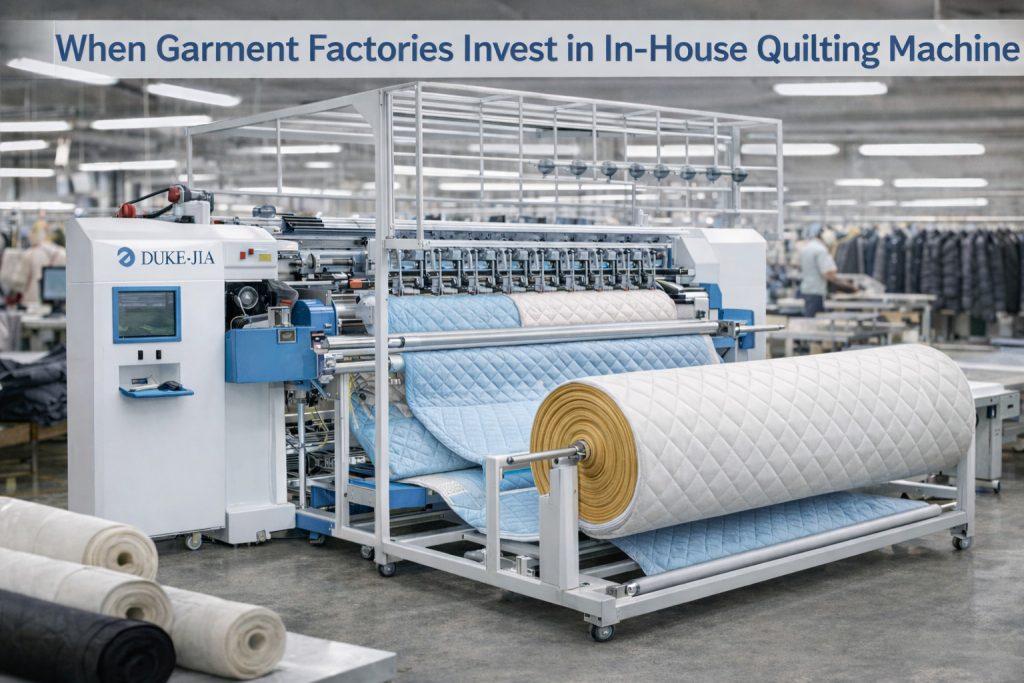
The modern garment industry thrives on efficiency, quality control, and the ability to add unique value to products. For many factories, especially those producing outerwear, home textiles, and specialized padded goods, managing the quilting process effectively is a critical element. The setup in the image illustrates how a modern industrial quilting machine fits into a value-addition line, enabling precise and efficient production. It raises the crucial question: When factories should invest in quilting machines in house rather than relying on external vendors.
Bringing quilting in-house is a strategic decision that can significantly impact a factory’s profitability, lead times, and design capabilities. This move transitions quilting from an outsourced bottleneck to an integrated value-addition process, offering greater control and flexibility.
Why Bring Quilting In-House? Addressing Shop Floor Challenges
Outsourcing quilting, while seemingly cost-effective initially, often introduces several challenges:
- Extended Lead Times: Dependence on external schedules can delay production cycles, impacting delivery commitments.
- Quality Control Issues: Inconsistent stitching, pattern misalignment, or material handling errors from third-party vendors can lead to rejects and rework.
- Minimum Order Quantities (MOQs): Small-batch or sample production becomes difficult and expensive.
- Lack of Design Flexibility & IP Risk: Proprietary designs might be exposed, and quick pattern changes are harder to implement.
- Hidden Costs: Transportation, supervision, and communication overheads add up.
An in-house industrial quilting machine directly addresses these problems. Factories producing items like jackets, vests, sleeping bags, mattress toppers, quilts, bedspreads, and even certain uniform or sportswear components benefit immensely.
Impact on Quality, Speed, and Running Costs
Investing in a modern quilting machine delivers tangible improvements across key operational metrics:
- Quality: Advanced computerized quilting machines ensure consistent stitch length, precise pattern registration, and uniform tension across entire panels. This results in superior product aesthetics, reduced defects, and higher overall product quality, leading to better product realization (FOB) and customer satisfaction.
- Speed & Throughput: Industrial machines are designed for high-speed operation, often capable of producing large quilted panels much faster than manual or semi-automated methods. Multi-needle machines, in particular, can quilt wide fabrics in a single pass, drastically cutting production time. This translates to faster turnaround, increased capacity, and the ability to meet tighter deadlines.
- Operator Comfort & Skill: Modern machines feature user-friendly Human-Machine Interfaces (HMIs) and ergonomic designs, reducing operator fatigue. While skilled operators are still essential, the precision and automation reduce the reliance on purely manual dexterity for consistent results.
- Power Consumption & Running Costs: Contemporary industrial quilting machines often incorporate energy-efficient servo motors that consume less power compared to older clutch motors. Furthermore, by eliminating outsourcing costs, transportation, and reducing rework due to quality issues, the overall running cost per unit can be significantly lowered. Optimized material utilization through precise pattern placement also minimizes fabric waste.
- Value-Addition & Margin: The ability to execute intricate, custom quilting patterns in-house allows factories to offer unique designs, differentiate their products, and command higher margins. This direct control over a key value-adding process enhances the factory’s competitive edge and supports a better Free on Board (FOB) price.
Technical Deep Dive: Understanding Industrial Quilting Machines
Industrial quilting machines primarily function on either a multi-needle or single-needle computer-controlled principle.
Working Principle:
In essence, the machine uses a set of needles (multi-needle) or a single needle (single-needle CNC) to stitch together multiple layers of fabric (top fabric, batting/wadding, backing fabric) in a predetermined pattern. The fabric layers are fed through the machine, tensioned, and moved according to programmed designs.
Stitch Formation:
Most industrial quilting machines use a lockstitch mechanism. A needle carries the upper thread through the fabric layers. A rotating hook or looper beneath the fabric catches the needle thread, forming a loop, and interlaces it with the bobbin thread (lower thread) to create a secure, durable stitch.
Key Components:
- Sewing Heads/Needle Bar: Holds the needles and mechanisms for stitch formation.
- Fabric Feeding System: Rollers, clamps, or conveyer belts precisely feed and tension the fabric layers.
- Machine Frame/Bed: Provides stability and support for the quilting area.
- Computer Control System (HMI): Allows operators to select, create, and modify quilting patterns, control speed, and monitor production.
- Motors: High-precision servo motors drive the needle bar, fabric feeding, and pattern movement for accurate and consistent stitching.
- Thread Break Detection: Sensors automatically stop the machine if a thread breaks, minimizing defects.
Typical Production Capacities:
- Multi-needle machines: Can quilt a full width of fabric (e.g., 2.4-meter wide) simultaneously, with production speeds often ranging from 100 to 300 stitches per minute (SPM) per needle, equating to high linear meter output for simpler patterns.
- Single-needle CNC machines: Offer unparalleled pattern versatility and precision for intricate designs. Production speeds vary significantly based on pattern complexity, but typically range from 500 to 1200 stitches per minute. Their strength lies in complex, individual panel quilting.
Maintenance and Daily Care for Optimal Performance
Regular maintenance is crucial for the longevity and consistent performance of quilting machines:
- Needles: Use the correct needle type and size for the fabric and thread. Replace needles regularly (e.g., every 8-10 hours of operation or at the start of a new shift) to prevent skipped stitches and fabric damage.
- Thread Path: Keep the thread path clean and free of lint. Ensure proper threading and tensioning to avoid thread breaks and inconsistent stitch formation.
- Cleaning: Daily cleaning of lint, dust, and fabric debris from the needle area, bobbin case, feed dogs, and tension discs is essential. Use compressed air cautiously, ensuring debris is blown away from critical components.
- Oiling: Follow the manufacturer’s guidelines for oiling. Many modern machines have automatic oiling systems, but manual lubrication points still need attention. Use only recommended industrial sewing machine oil.
- Calibration & Checks: Periodically check and calibrate thread tensions, pattern alignment, and synchronization of feeding mechanisms. Regular review of stitch quality and consistency is a good indicator of machine health.
Choosing the Right Quilting Machine: A Comparison & Buying Guide
The market offers a range of industrial quilting machines. Understanding the differences is key to making the right investment.
Comparison: Machine Types & Origins
| Feature | Modern Computer-Controlled Machines (e.g., DukeJia) | Older Mechanical/Semi-Mechanical Machines |
|---|---|---|
| Pattern Flexibility | Unlimited, programmable via HMI, easy to change patterns. | Limited, often cam-driven, pattern changes are complex and time-consuming. |
| Precision & Quality | High accuracy, consistent stitch length, minimal defects, superior pattern alignment. | Variable, prone to human error, less consistent quality, difficult for complex patterns. |
| Speed & Efficiency | High speed, servo motor control, energy-efficient. | Lower speed, less efficient motors, often require more manual intervention. |
| Ease of Use | User-friendly HMI, pattern memory, automated functions. | More manual adjustments, steeper learning curve. |
| Maintenance | Less frequent major overhauls, but requires technical understanding of electronics. | Requires regular mechanical adjustments, parts wear faster. |
| Data & Connectivity | Often capable of production data logging, network integration. | No digital data logging. |
Factories often weigh Japanese/European machines vs. Chinese/other Asian machines. While Japanese/European machines are renowned for their robust build, extreme precision, and very long lifespan, they come at a significant premium. Modern Chinese and other Asian machines, such as those from DukeJia, have closed the gap considerably in terms of technology, build quality, and precision, offering an excellent balance of performance, reliability, and cost-effectiveness. They integrate advanced computer controls, servo motors, and robust frames, making them a highly viable option for high-volume, quality-conscious production.
Buying Guide / Selection Checklist:
- Production Volume & Product Type:
- High volume, consistent patterns (e.g., mattress pads, basic quilts): Consider multi-needle machines.
- Lower volume, high-complexity, bespoke patterns (e.g., fashion jackets, detailed home textiles): Single-needle CNC is ideal.
- Fabric Width & Roll Size: Ensure the machine’s working width accommodates your common fabric sizes.
- Pattern Requirements: Do you need standard patterns, or intricate custom designs? Computerized machines offer maximum flexibility.
- Automation Level: Automatic thread trimming, pattern memory, auto stop for thread breaks save labor and improve efficiency.
- Budget vs. Features: Balance initial investment with long-term operational savings and value-addition capabilities.
- After-Sales Support: Crucial for any industrial machinery. Check for installation, training, spare parts availability, and service response time.
- Energy Efficiency: Look for machines with servo motors for lower power consumption.
Troubleshooting Common Quilting Machine Issues
Even with the best machines, issues can arise. Here are some common problems and basic solutions:
| Common Fault | Likely Causes | Basic Solutions |
|---|---|---|
| Skipped Stitches | Incorrect needle size/type, bent/blunt needle, improper threading, tension issues. | Replace needle, rethread machine, adjust tension. |
| Thread Breakage | Incorrect tension, worn needle eye, burrs on thread path, poor thread quality, incorrect needle. | Check/adjust tension, replace needle, inspect thread path, use quality thread. |
| Uneven Stitches | Incorrect tension, inconsistent material feeding, worn parts in stitch formation. | Adjust top and bobbin tension, check feed system, inspect for worn components. |
| Pattern Misalignment | Loose fabric clamps, incorrect pattern programming, worn machine parts, fabric slippage. | Re-clamp fabric, verify pattern coordinates, check feeding mechanism. |
| Noise/Vibration | Lack of lubrication, loose components, worn bearings. | Lubricate according to manual, tighten loose screws, inspect for worn parts. |
For more complex issues, professional technical support is always recommended.
Your Partner in Value-Addition: DukeJia & Hari Chand Anand & Co. (HCA)
DukeJia, represented in India by Hari Chand Anand & Co. (HCA), understands the critical role of advanced machinery in modern garment production. We are a leading value-addition machinery partner for garment factories across India, supplying and servicing industrial embroidery, perforation, and quilting machines.
Our range of industrial quilting machines is designed to meet the diverse needs of factories producing high-quality jackets, home textiles, and other padded products, enabling all-over quilting with precision and speed. Beyond quilting, we also offer state-of-the-art industrial embroidery machines for logo and placement embroidery, appliqué, and perforation/laser machines for sportswear and intricate design details.
HCA prides itself on comprehensive after-sales support. Our experienced teams provide professional installation, thorough operator training, proactive preventive maintenance schedules, ensuring genuine spares availability, and prompt on-call service teams across key manufacturing hubs including Delhi NCR, Tirupur, Ludhiana, Chennai, Bengaluru, and more. This ensures your investment continues to deliver maximum productivity with minimal downtime.
Frequently Asked Questions
What are the primary advantages of bringing quilting in-house?
Bringing quilting in-house helps factories overcome challenges like extended lead times from third-party vendors, inconsistent quality control, high minimum order quantities (MOQs), and limited design flexibility. It grants greater control over production schedules, quality, and proprietary designs.
What is the difference between multi-needle and single-needle CNC quilting machines?
Multi-needle machines are ideal for high-volume production of consistent, simpler patterns across wide fabrics, quilting multiple lines simultaneously. Single-needle CNC machines offer superior versatility and precision for intricate, complex, and bespoke patterns on individual panels, albeit at varying speeds depending on design complexity.
How do modern quilting machines impact product quality and speed?
Modern computerized quilting machines ensure consistent stitch length, precise pattern registration, and uniform tension, leading to superior aesthetics and fewer defects. Their high-speed operation, often with multi-needle capabilities and servo motors, drastically cuts production time, increases throughput, and allows factories to meet tighter deadlines.
What kind of maintenance is essential for industrial quilting machines?
Key maintenance includes regularly replacing needles (e.g., every 8-10 hours), keeping the thread path clean, daily cleaning of lint and debris, following manufacturer’s oiling guidelines, and periodically checking/calibrating thread tensions and pattern alignment. This ensures longevity and consistent performance.
Why should a factory consider DukeJia (HCA) for their quilting machine investment?
DukeJia machines offer an excellent balance of advanced technology, build quality, precision, and cost-effectiveness, competitive with renowned brands. HCA provides comprehensive after-sales support including professional installation, operator training, preventive maintenance, genuine spares, and prompt service across major Indian manufacturing hubs, ensuring maximum uptime and productivity for your investment.
For DukeJia embroidery, perforation or quilting machine demonstrations, pricing or technical consultation, contact Hari Chand Anand & Co. (HCA), New Delhi.