
Published on: 23 Feb 2026
Optimizing Factory Layouts for Embroidery, Quilting & Sewing: A DukeJia Guide
Key takeaways for garment factories:
- Strategic factory layout is crucial for maximizing productivity, maintaining quality, and controlling costs in embroidery, quilting, and sewing operations.
- Modern industrial machinery from DukeJia/HCA improves quality, speed, operator comfort, and reduces running costs through automation and precision.
- Understanding the technical principles and maintenance requirements of value-addition machines ensures sustained operation and effective layout planning.
- Higher automation provides superior ROI through efficiency, flexibility, and enhanced product value, justifying the initial investment for most growing businesses.
- Comprehensive after-sales support, including installation, training, preventive maintenance, and genuine spares, is vital for minimizing downtime and maximizing machine longevity.
Table of Contents
- Optimizing Production Flow: Planning Factory Layout for Embroidery Quilting and Sewing Lines
- Technical Aspects of Value-Addition Machinery Integration
- Comparison: Automation vs. Basic Models
- DukeJia & Hari Chand Anand & Co. (HCA) Partnership
- Troubleshooting Common Issues
- Buying Guide / Selection Checklist for Decision Makers
- Frequently Asked Questions
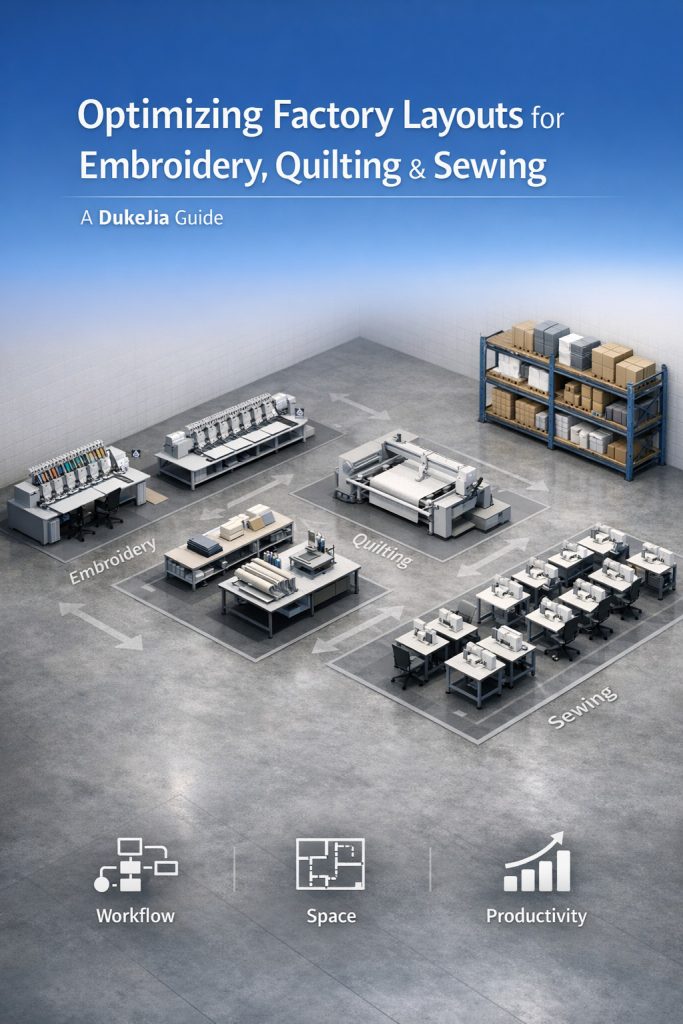
The setup in the image illustrates how a modern industrial embroidery, quilting, or laser machine integrates into a value-addition production line, optimized for efficiency and material flow. Effective planning factory layout for embroidery quilting and sewing lines is critical for any garment manufacturer looking to maximize productivity, maintain quality, and control operational costs. This strategic approach ensures seamless workflow, reduces bottlenecks, and supports advanced value-addition processes that differentiate products in a competitive market.
Optimizing Production Flow: Planning Factory Layout for Embroidery Quilting and Sewing Lines
For factory owners, production managers, industrial engineers, and even maintenance teams, a well-thought-out layout is foundational. It directly impacts the entire production cycle, from raw material receipt to finished goods dispatch. In value-addition processes like industrial embroidery, quilting, and laser perforation, the placement of machinery relative to upstream and downstream operations is paramount.
These advanced technologies are employed across a wide array of products:
- T-shirts, polos, knitwear: Logo embroidery, appliqué, embellishments.
- Jackets & Outerwear: All-over quilting, intricate embroidery designs, laser-cut details.
- Home Textiles: Decorative quilting for bedspreads, cushion covers, laser patterns on curtains.
- Uniforms & Workwear: Durable logo embroidery, identification marking.
- Sportswear: Perforation for breathability, decorative laser cutting, functional quilting.
Problems Solved by Strategic Layout and Modern Machinery
A poorly planned layout can lead to excessive material handling, operator fatigue, increased work-in-progress (WIP), and production delays. Modern DukeJia industrial machines, distributed and serviced by Hari Chand Anand & Co. (HCA), address these challenges by offering:
- Improved Quality: Precision control in computerized systems ensures consistent stitch quality, accurate pattern placement, and clean laser cuts, reducing rework.
- Enhanced Speed & Throughput: Multi-head embroidery machines, high-speed quilting systems, and rapid laser cutting increase parts per minute, boosting overall factory output.
- Operator Comfort & Safety: Ergonomic machine designs, reduced manual intervention through automation, and integrated safety features contribute to a better working environment.
- Optimized Power Consumption: Modern servo motors and efficient laser sources consume less energy compared to older mechanical counterparts, lowering running costs.
- Reduced Running Cost: Features like automatic thread trimming, intelligent pattern recognition, and precise material handling minimize material waste and labor input.
- Higher Value Addition (FOB/Margin): The ability to offer intricate designs, functional perforations, and premium quilting elevates product aesthetics and utility, commanding better Free-On-Board (FOB) prices and improved profit margins.
Technical Aspects of Value-Addition Machinery Integration
Understanding the working principles and maintenance requirements is crucial for effective layout planning and sustained operation.
Industrial Embroidery Machines
Working Principle: Computerized multi-head embroidery machines operate on a precisely synchronized X-Y frame movement system. Each head has its own set of needles and a rotary hook assembly. The machine reads a digitized design file (.DST, .EXP, etc.), which dictates needle selection, stitch type, and frame movement.
Key Components:
- Embroidery Head: Contains needle bars, presser foot, thread guides, and tensioners.
- Rotary Hook: Forms the lock stitch by catching the needle thread and wrapping it around the bobbin thread.
- Pantograph/Frame: Holds the fabric securely and moves it in X-Y directions according to the design.
- Control Panel: User interface for pattern loading, parameter setting, and machine operation.
- Servo Motors: Provide precise and high-speed movement for the pantograph and needle bars.
Stitch Formation: A lock stitch is formed when the needle carrying the top thread penetrates the fabric, forms a loop, and the rotary hook catches this loop, passing it around the bobbin case containing the bobbin thread. This creates an interlocking stitch.
Typical Production Capacities: Speeds typically range from 800 to 1200 stitches per minute (SPM) per head, depending on design complexity and material. A 20-head machine can process a significant volume daily.
Quilting Machines
Working Principle: Modern industrial quilting machines, especially multi-needle computerized models, use multiple sewing heads to create patterns across large fabric panels. The fabric (typically a sandwich of top fabric, batting, and backing) is fed through the machine, and the sewing heads move synchronously to produce the desired stitch pattern, controlled by a computer program.
Key Components:
- Sewing Heads: Individual needle, feed dog, and hook assemblies.
- Frame/Material Feeding System: Accurately guides large fabric rolls or panels.
- Control System: Stores and executes quilting patterns.
Stitch Formation: Similar to a lock stitch in embroidery, but designed for continuous, high-speed stitching over large areas.
Typical Production Capacities: Depending on machine width and pattern complexity, these machines can quilt several meters per minute, making them highly efficient for jacket panels or home textile products.
Perforation / Laser Machines
Working Principle: High-precision laser machines use a focused CO2 laser beam to cut, etch, or perforate textiles. The laser beam is directed by a series of mirrors and lenses onto the fabric, vaporizing material in its path. Computer Numerical Control (CNC) ensures precise pattern execution.
Key Components:
- CO2 Laser Source: Generates the laser beam.
- Galvanometer Scanner / Gantry System: Directs the laser beam across the material.
- Exhaust System: Removes fumes and debris generated during cutting.
- Control Software: Manages laser power, speed, and pattern data.
Typical Production Capacities: Laser cutting speeds vary significantly based on material type and thickness, from centimeters to several meters per second for perforation patterns.
Maintenance and Daily Care
Regular maintenance is vital for longevity and consistent performance:
- Needles: Change regularly, matched to fabric and thread type.
- Thread Path: Clean thread guides and tension discs daily.
- Cleaning: Remove lint and debris from hook areas, needle bars, and machine surfaces.
- Oiling: Follow manufacturer guidelines for lubrication points (e.g., rotary hooks, moving parts).
- Calibration: Periodically check and calibrate tensions, laser alignment, and machine synchronization.
Comparison: Automation vs. Basic Models
| Feature | Mechanical / Semi-Mechanical (Older Gen) | Fully Computer-Controlled / Modern (DukeJia) | Justification |
|---|---|---|---|
| Control & Precision | Manual adjustments, limited pattern memory, prone to human error. | Digital control, vast pattern memory, precise repeatability, auto-correction. | Critical for consistent quality, complex designs, and brand standards. |
| Speed & Throughput | Lower speeds, more manual intervention, slower setup. | High SPM (embroidery), faster quilting, quick pattern changes, multi-head efficiency. | Essential for meeting tight deadlines and high production volumes. |
| Flexibility | Limited pattern options, difficult to switch between designs. | Easy pattern loading, scaling, rotation; adaptable to diverse products. | Ideal for factories with varied product lines and seasonal changes. |
| Automation Features | Manual thread trimming, limited sensor feedback. | Automatic thread trimming, color changes, tension control, fault detection. | Reduces labor, minimizes waste, improves operator efficiency. |
| Power & Running Cost | Often less energy-efficient motors, higher wear and tear. | Energy-efficient servo motors, reduced material waste, lower maintenance frequency. | Long-term operational savings and environmental benefits. |
| Build Quality & Life | Varies, but older designs may have less robust components. | High-quality components (e.g., Japanese/European standard parts in DukeJia machines), durable build. | Ensures machine longevity and consistent performance over years. |
| Price Point | Lower initial investment. | Higher initial investment, but superior ROI through efficiency and value. | Consider total cost of ownership (TCO) over upfront price. |
Higher automation (multi-head, automatic trimming, pattern memory, integrated design software) is justified when:
- Producing high volumes of similar or varying designs.
- Requiring complex, repeatable patterns with minimal error.
- Labor costs are a significant factor.
- Seeking to enhance product value and achieve higher FOBs.
- Flexibility for rapid design changes is necessary.
Basic models might suffice for very low production volumes, simple, unchanging designs, or where budget constraints are extremely tight and future growth is not a primary concern.
DukeJia & Hari Chand Anand & Co. (HCA) Partnership
DukeJia, represented in India by Hari Chand Anand & Co. (HCA), is a dedicated value-addition machinery partner for garment factories. We specialize in supplying and servicing state-of-the-art industrial embroidery, perforation, and quilting systems across India, with strong presence in Delhi NCR, Tirupur, Ludhiana, Chennai, Bengaluru, and other key textile hubs.
Our product range supports diverse applications:
- Logo and Placement Embroidery: For uniforms, corporate wear, and fashion apparel.
- All-Over Quilting: For jackets, bedspreads, and automotive textiles.
- Sportswear Perforation: For enhanced breathability and aesthetic appeal.
- Appliqué: Adding dimension and texture to garments.
- Home Textile Quilting: For decorative and functional household items.
HCA prides itself on comprehensive after-sales support, which is critical for maintaining uptime in a factory setting. Our services include:
- Professional Installation: Ensuring optimal machine setup and calibration.
- Operator & Technician Training: Equipping your team with the skills for efficient operation and basic troubleshooting.
- Preventive Maintenance Schedules: Proactive service to prevent breakdowns and extend machine life.
- Genuine Spares: Ready availability of authentic parts to minimize downtime.
- On-Call Service Teams: Rapid response to technical issues, ensuring your production keeps running smoothly.
Troubleshooting Common Issues
| Common Fault | Likely Cause | Basic Solution |
|---|---|---|
| Skipped Stitches (Embroidery/Quilting) | Incorrect needle, dull needle, improper tension, timing issue. | Replace needle, adjust thread tension, check machine timing (call service if needed). |
| Thread Breakage (Embroidery/Quilting) | Incorrect tension, burr on thread path, poor quality thread, faulty needle. | Re-thread machine, check for burrs, use quality thread, replace needle. |
| Poor Stitch Quality / Looping | Incorrect tension (top or bobbin), wrong bobbin winding. | Adjust top and bobbin tensions, re-wind bobbin correctly. |
| Fabric Puckering | Incorrect hooping/framing, wrong fabric stabilizer, tension issues. | Re-hoop fabric firmly but not stretched, use appropriate stabilizer, adjust tension. |
| Inaccurate Laser Cut/Perforation | Dirty lens/mirror, improper focus, incorrect laser power/speed settings. | Clean optics, re-focus laser, adjust power/speed parameters in software. |
| Machine Noise / Vibration | Lack of lubrication, loose components, worn parts. | Lubricate moving parts, tighten fasteners, inspect for worn components. |
Buying Guide / Selection Checklist for Decision Makers
When investing in new value-addition machinery, consider these factors:
- Production Volume & Growth Plans: Does the machine’s capacity meet current needs and future expansion?
- Product Range & Versatility: Can it handle the variety of fabrics and designs your factory processes or plans to introduce?
- Level of Automation Required: Is multi-head, automatic trimming, and advanced programming essential for your efficiency and quality goals?
- Integration with Existing Lines: How seamlessly will it fit into your current factory layout and workflow? Consider space, power, and material flow.
- Operator Skill & Training: What is the learning curve? Is comprehensive training provided?
- After-Sales Support & Spares: Is reliable service, preventive maintenance, and genuine spare parts readily available (like from HCA)?
- Power Consumption & Running Costs: Analyze the long-term operational costs beyond the initial purchase price.
- Budget & ROI: Calculate the return on investment based on increased efficiency, higher value addition, and reduced waste.
- Technology & Features: Are you buying into outdated technology or a modern, future-proof system?
- Vendor Reputation: Choose a trusted partner like DukeJia/HCA with a proven track record in the industry.
Frequently Asked Questions
What is the primary benefit of optimizing factory layout for embroidery and quilting?
The primary benefit is improved operational efficiency, which translates to reduced material handling, minimized bottlenecks, faster production cycles, and lower operational costs. A well-planned layout enhances workflow and productivity significantly.
How do modern DukeJia machines contribute to better product quality?
Modern DukeJia machines utilize computerized precision control, ensuring consistent stitch quality for embroidery and quilting, accurate pattern placement, and clean, precise laser cuts. This reduces the need for rework and helps maintain high brand standards.
Is the higher initial investment in automated machinery justified for a growing garment factory?
Yes, for a growing factory, the higher initial investment is often justified by a superior Return on Investment (ROI) derived from increased throughput, reduced labor costs, minimized material waste, enhanced product value, and greater flexibility for diverse designs. These factors contribute to higher profit margins in the long term.
What kind of after-sales support does Hari Chand Anand & Co. (HCA) provide?
HCA offers comprehensive after-sales support including professional installation, operator and technician training, preventive maintenance schedules, ready availability of genuine spare parts, and responsive on-call service teams to ensure maximum machine uptime and longevity.
What are common causes of thread breakage in embroidery or quilting machines?
Common causes include incorrect thread tension, burrs or rough spots along the thread path, using poor quality thread, or a faulty/dull needle. Regular maintenance and using appropriate high-quality materials can prevent most instances.
How can I ensure accurate laser cutting or perforation?
To ensure accuracy, regularly clean the laser machine’s lens and mirrors, ensure proper laser focus, and calibrate power and speed settings according to the material type and thickness using the control software. HCA provides training on these aspects.
For DukeJia embroidery, perforation or quilting machine demonstrations, pricing or technical consultation, contact Hari Chand Anand & Co. (HCA), New Delhi.