
Published on: 05 Jan 2026
Perforation Machines for Sportswear & Athleisure: Elevating Performance & Design in Garment Manufacturing
Key takeaways for garment factories:
- Advanced perforation technology is crucial for creating high-performance, aesthetically appealing activewear, seamlessly integrating into value-addition lines.
- Laser perforation machines offer unparalleled precision, non-fraying edges, design flexibility, and consistency, significantly outperforming traditional mechanical methods.
- Investing in DukeJia’s state-of-the-art perforation systems boosts product quality, increases production speed, reduces material waste, and ultimately enhances profit margins through value-added features.
- Key components like laser sources, galvanometer scanners, and vision systems contribute to high-speed, automated processing, with roll-to-roll systems processing hundreds of meters per hour.
- Hari Chand Anand & Co. (HCA) provides comprehensive after-sales support across India, including installation, training, genuine spares, and responsive service, ensuring maximum uptime and ROI for your DukeJia machinery.
Table of Contents
- Perforation Machines for Sportswear and Athleisure Units: Enhancing Performance and Design
- The Core Need: Why Perforation Matters in Activewear
- Technical Deep Dive: How Perforation Machines Work
- Benefits on the Shop Floor: Quality, Speed, and Cost Efficiency
- Modern Perforation Technology vs. Traditional Methods
- Maintaining Peak Performance: Essential Care and Troubleshooting
- Maximizing ROI: A Buying Guide for Perforation Machines
- DukeJia & HCA: Your Partner in Advanced Garment Value-Addition
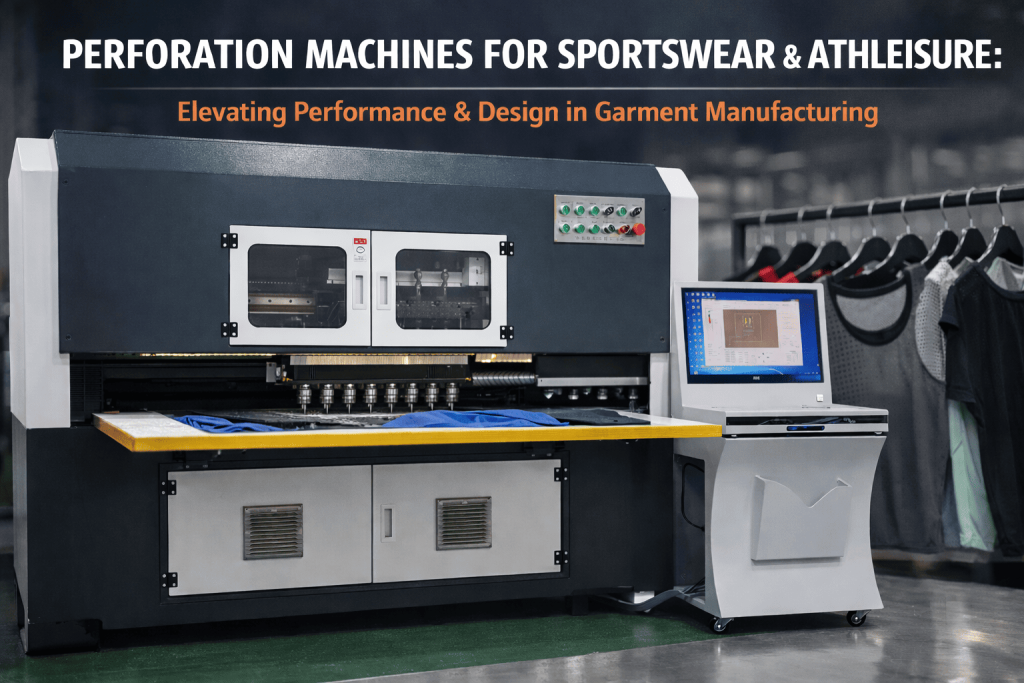
The machine shown above is a prime example of advanced perforation technology installed in a modern garment factory, illustrating how this solution seamlessly integrates into a value-addition line. In the dynamic world of textile manufacturing, the demand for high-performance and aesthetically appealing activewear is constantly growing. At the forefront of meeting this demand are advanced industrial perforation machines for sportswear and athleisure units, revolutionizing how garment factories approach both functionality and design.
Perforation Machines for Sportswear and Athleisure Units: Enhancing Performance and Design
For garment factory owners, production managers, industrial engineers, and maintenance teams, investing in the right machinery is crucial for staying competitive. Perforation technology, particularly laser-based systems, offers a compelling advantage in the booming sportswear and athleisure markets. DukeJia, represented in India by Hari Chand Anand & Co. (HCA), is a leading value-addition machinery partner, supplying and servicing these critical systems across key manufacturing hubs like Delhi NCR, Tirupur, Ludhiana, Chennai, and Bengaluru.
The Core Need: Why Perforation Matters in Activewear
Perforation machines are essential for creating specialized fabrics used in high-performance garments. This technology is widely adopted for:
- Sportswear: Enhancing breathability in jerseys, running shorts, cycling wear, and specialized jackets by creating ventilation zones.
- Athleisure: Adding unique design elements and improving comfort in hoodies, leggings, and track pants.
- Activewear: Facilitating moisture management and reducing garment weight.
- Footwear Components: Creating breathable panels for athletic shoes.
Problems Solved on the Shop Floor:
Traditional methods like mechanical punching or manual processes often result in inconsistent perforations, frayed edges, material distortion, and significant labor costs. Modern perforation machines, especially laser systems, solve these by providing:
- Precision and Consistency: Identical perforations across thousands of units, critical for brand quality.
- Design Flexibility: Ability to create intricate patterns and fine details impossible with other methods.
- Non-Fraying Edges: Laser sealing prevents material unraveling, crucial for durable activewear.
- Reduced Material Waste: Optimized nesting and precise cutting minimize scrap.
- Increased Speed and Throughput: High-speed processing of large volumes.
This directly translates to higher product quality, enabling better FOB (Free On Board) prices or improved margins for garment manufacturers. Value-added features like enhanced breathability and unique aesthetics differentiate products in a crowded market.
Technical Deep Dive: How Perforation Machines Work
While there are mechanical punching perforation systems, for precision and versatility in sportswear, laser perforation machines are the industry standard.
Working Principle (Laser Perforation):
Laser perforation involves a focused high-energy laser beam (typically CO2 or Fiber laser) that vaporizes material at specific points, creating holes. The beam is directed by a sophisticated galvanometer scanning system or a moving cutting head, following pre-programmed patterns. The non-contact nature of laser processing ensures no tool wear and minimal material stress.
Key Components and Their Role:
- Laser Source: Generates the laser beam (e.g., CO2 laser for most textiles, Fiber laser for some synthetics).
- Beam Delivery System: Mirrors and lenses guide and focus the laser beam onto the material.
- Galvanometer Scanners / Cutting Head: High-speed mirrors rapidly position the laser beam to create perforations at precise locations, or a gantry-style cutting head moves over a larger area.
- Conveyor System / Work Bed: Holds and transports the fabric (often roll-to-roll or flatbed) under the laser head, ensuring continuous and automated processing.
- Vision System (Optional but Recommended): Cameras detect material position, distortions, or print marks for precise alignment, especially for patterned fabrics.
- Control Software: Manages laser power, speed, perforation patterns, and material feeding, often integrated with CAD systems.
- Exhaust and Filtration System: Crucial for safety and air quality, removing fumes and particulate matter generated during laser processing.
Typical Production Capacities:
Modern laser perforation machines can achieve impressive speeds, ranging from 0.5 to 2 meters per second for scanning large areas with perforation patterns. Roll-to-roll systems can process entire fabric rolls continuously, with throughputs varying significantly based on pattern density and material type, often processing tens to hundreds of meters of fabric per hour. Some systems can perforate multiple garments or panels simultaneously.
Benefits on the Shop Floor: Quality, Speed, and Cost Efficiency
- Quality: Laser technology delivers unparalleled precision, clean hole edges without fraying, and consistent pattern repetition, ensuring a premium finish every time.
- Speed: High-speed laser scanning and automated material handling dramatically reduce production time compared to manual or die-cutting methods. Continuous roll-to-roll systems allow for uninterrupted processing.
- Operator Comfort: Automated systems reduce the physical strain on operators, requiring minimal manual intervention once the program is set.
- Power Consumption: Modern laser systems are designed for energy efficiency, with intelligent power management that optimizes laser usage.
- Running Cost: Lower waste generation, reduced labor requirements, minimal consumables (no dies to replace), and efficient energy use contribute to a lower overall running cost and higher profitability.
Modern Perforation Technology vs. Traditional Methods
Understanding the evolution of perforation methods highlights the advantages of contemporary systems.
| Feature | Traditional/Manual Perforation (e.g., Die-Cutting) | Modern Laser Perforation |
|---|---|---|
| Method | Mechanical force, custom dies | Focused laser beam (CO2, Fiber) |
| Precision | Good, but subject to die wear and operator alignment | Extremely high, computer-controlled to micrometre level |
| Edge Quality | Can fray, requires post-processing for some materials | Fused/sealed edges, no fraying, clean finish |
| Design Flexibility | Limited to die shapes, expensive to change designs | Virtually unlimited, easily programmable, no tooling costs |
| Speed | Batch processing, can be fast for simple, high-volume cuts | High-speed continuous processing, variable for pattern density |
| Material Handling | Manual placement, risk of distortion | Automated conveyor, vision systems for precise alignment |
| Material Waste | Can be high due to fixed die layouts | Optimized nesting, minimal waste |
| Tooling/Consumables | Expensive dies, wear out, require storage | No physical tooling, only laser tube/optics maintenance |
| Automation | Low to semi-automated | High-level automation, integrated with CAD/CAM |
| Maintenance | Die sharpening, mechanical part lubrication | Optics cleaning, laser source checks, exhaust system care |
When Higher Automation is Justified:
For high-volume production, intricate and frequently changing designs, diverse material types, and a need for superior finish quality, fully computer-controlled laser perforation systems are highly justified. They offer unparalleled flexibility and efficiency, paying for themselves through increased productivity and enhanced product value. For simpler, consistent perforation needs on durable materials, basic mechanical systems might suffice, but at the cost of design flexibility and edge quality.
Maintaining Peak Performance: Essential Care and Troubleshooting
Effective maintenance ensures longevity and consistent performance.
Maintenance and Daily Care:
- Optics Cleaning: Regularly clean laser lenses and mirrors with appropriate solutions to ensure maximum beam power and clarity.
- Exhaust System Check: Ensure the exhaust fan and filter system are clear and functioning efficiently to remove fumes and debris.
- Work Bed / Conveyor Cleaning: Keep the work surface clean of debris to prevent material snags and ensure smooth feeding.
- Calibration: Periodically check and calibrate the laser beam alignment and focus for consistent perforation quality.
- Software Updates: Keep control software updated to benefit from performance improvements and new features.
Troubleshooting (Common Faults & Basic Solutions):
| Fault | Likely Cause | Basic Solution |
|---|---|---|
| Uneven / Incomplete Perforations | Dirty optics, incorrect laser power/speed, focus issues | Clean lenses, adjust power/speed, re-calibrate focus |
| Frayed Edges | Incorrect laser parameters (power too low, speed too high) | Increase laser power or decrease speed slightly |
| Slow Processing Speed | Optimized pattern not used, software settings, material type | Review pattern for efficiency, check software settings, use recommended parameters for material |
| Material Jamming / Misalignment | Dirty conveyor, incorrect material tension, vision system error | Clean conveyor, adjust tension, recalibrate vision system |
| Machine Not Starting / Power Issue | Emergency stop engaged, power supply fault, interlock switch | Check E-stop, ensure power connection, consult manual for interlocks |
Maximizing ROI: A Buying Guide for Perforation Machines
When considering a perforation machine, decision-makers should evaluate several factors to ensure optimal return on investment:
- Application Specifics: What materials will you process? What hole sizes and patterns are required? Laser systems are best for intricate designs and non-fraying edges on synthetics.
- Production Volume: Match machine capacity (speed, work area) to your anticipated output.
- Automation Level: Do you need manual feeding or a fully automated roll-to-roll system with vision recognition?
- Laser Source Type & Power: CO2 lasers are common for textiles; power levels determine speed and material thickness capability.
- Software & Integration: Look for user-friendly software that integrates with existing CAD/CAM systems.
- After-Sales Support: Crucial for industrial machinery. Evaluate the supplier’s installation, training, spare parts, and service network.
DukeJia & HCA: Your Partner in Advanced Garment Value-Addition
DukeJia, through Hari Chand Anand & Co. (HCA), is committed to equipping Indian garment factories with world-class value-addition machinery. We supply and service industrial embroidery, perforation, and quilting systems designed to meet the evolving demands of the textile industry. From precision sportswear perforation and intricate logo embroidery to all-over quilting for jackets and home textiles, our solutions empower manufacturers to elevate their product offerings.
Our commitment extends beyond machinery sales. HCA provides comprehensive after-sales support including professional installation, extensive operator and technician training, robust preventive maintenance programs, ready availability of genuine spares, and responsive on-call service teams across major manufacturing hubs in India. We ensure your machines operate at peak efficiency, minimizing downtime and maximizing productivity.
Frequently Asked Questions
What types of garments benefit most from perforation technology?
Perforation technology is highly beneficial for sportswear, athleisure wear, activewear, and even footwear components. It enhances breathability, moisture management, reduces weight, and allows for unique aesthetic designs in items like jerseys, running shorts, leggings, and athletic shoes.
What is the main difference between laser and mechanical perforation?
Laser perforation uses a focused high-energy beam to vaporize material, resulting in extremely precise, consistent holes with non-fraying, sealed edges. Mechanical perforation (like die-cutting) uses physical force and custom dies, which can lead to inconsistencies, frayed edges, and limited design flexibility, besides requiring tooling costs.
How does DukeJia / HCA support customers after purchase?
DukeJia, through HCA, offers comprehensive after-sales support including professional installation, extensive operator and technician training, robust preventive maintenance programs, ready availability of genuine spare parts, and responsive on-call service teams across major manufacturing hubs in India to ensure maximum machine uptime and efficiency.
Can DukeJia perforation machines handle different types of fabrics?
Yes, DukeJia laser perforation machines are highly versatile and can process a wide range of textile materials, including various synthetics (polyester, nylon, spandex blends) common in activewear, and even some natural fibers. The laser source (CO2 or Fiber) is selected based on the specific material properties for optimal results.
What are the key benefits of investing in a DukeJia perforation machine?
Key benefits include superior product quality with precise, non-fraying perforations, significantly increased production speed and throughput due to automation, enhanced design flexibility, reduced material waste, lower running costs, and ultimately higher profitability through value-added product features.
What kind of maintenance is required for laser perforation machines?
Regular maintenance involves cleaning laser optics (lenses and mirrors), checking and cleaning the exhaust and filtration system, keeping the work bed/conveyor clean, periodic calibration of the laser beam, and keeping control software updated. HCA provides training and support for these essential maintenance tasks.
For DukeJia embroidery, perforation or quilting machine demonstrations, pricing or technical consultation, contact Hari Chand Anand & Co. (HCA), New Delhi.