
Published on: 30 Dec 2025
Quilting Machines for Jackets & Home Textiles: Enhance Value & Efficiency
Key takeaways for garment factories:
- Industrial quilting machines are essential for value addition in jacket and home textile production, significantly improving product quality and operational efficiency.
- Modern, computer-controlled quilting machines offer superior precision, higher speeds, and vast design versatility compared to older mechanical models.
- Consistent maintenance, including daily cleaning, regular oiling, and timely part replacement, is crucial for ensuring the longevity and optimal performance of these machines.
- Strategic investment in machines with higher automation is justified for factories aiming to produce diverse patterns, handle high volumes, or specialize in premium, intricate products.
- When selecting a quilting machine, factories must carefully assess their production needs, desired features, and, most importantly, the reliability and comprehensiveness of the supplier’s after-sales support.
Table of Contents
- Quilting Machines for Jacket and Home Textile Production: Enhancing Value and Efficiency
- The Mechanism of Industrial Quilting
- Operational Benefits: Quality, Speed, and Cost Efficiency
- Maintenance and Daily Care for Optimal Performance
- The Evolution of Quilting Technology: Comparisons
- Choosing the Right Quilting Machine: A Buying Guide
- Common Troubleshooting and Basic Solutions
- Key Takeaways
- Frequently Asked Questions
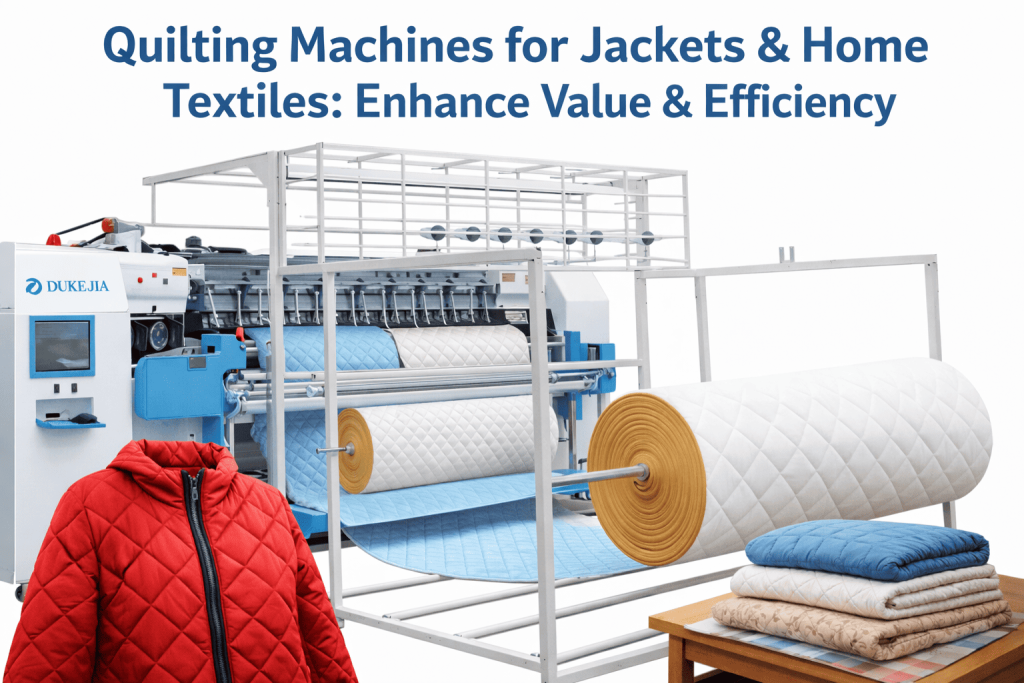
The machine shown above is installed in a modern garment factory, illustrating how advanced quilting solutions integrate seamlessly into value-addition lines. For garment manufacturers and home textile producers, the ability to create intricate patterns and durable quilted products is a significant competitive advantage. This article delves into the critical role of quilting machines for jacket and home textile production, exploring their technical aspects, operational benefits, and how they drive profitability.
Quilting Machines for Jacket and Home Textile Production: Enhancing Value and Efficiency
Quilting, the process of stitching together multiple layers of fabric with a padded material in between, transforms simple textiles into products with enhanced insulation, texture, and aesthetic appeal. In garment manufacturing, this is particularly crucial for items like jackets, coats, and vests, where warmth, drape, and design are paramount. For home textiles, quilting machines are indispensable for producing high-quality comforters, quilts, bedspreads, cushion covers, and mattress pads.
From a garment factory perspective, investing in advanced quilting technology addresses several key challenges: inconsistent stitch quality, slow production speeds associated with manual methods, high labor costs, and limited design versatility. Modern industrial quilting machines solve these problems by delivering uniform patterns, high throughput, and the flexibility to execute complex designs with precision.
The Mechanism of Industrial Quilting
Industrial quilting machines operate on sophisticated principles to ensure consistent quality and high efficiency. At their core, these machines create a lock stitch or chain stitch, binding the fabric layers and batting together.
Working Principle:
Most industrial quilting machines are multi-needle, computer-controlled systems. A large frame holds the fabric sandwich (top fabric, batting, backing fabric) taut. The machine head, equipped with multiple needles arranged in a straight line or pattern, moves across the fabric, simultaneously creating rows of stitches. Computer Numeric Control (CNC) software guides the machine head and/or the fabric frame to execute pre-programmed patterns, ranging from simple grids and lines to intricate curvilinear designs.
Key Components and Their Role:
- Needle Bar Assembly: Houses multiple needles that reciprocate vertically to penetrate the fabric layers.
- Looper/Bobbin System: Located beneath the sewing plate, these components interact with the needles to form the stitches. For lock stitch, bobbins hold the lower thread; for chain stitch, loopers form thread loops.
- Fabric Feed Mechanism: A precise system, often using rollers or clamps, to advance the fabric uniformly, ensuring consistent stitch length and pattern alignment.
- Computerized Control Panel: The brain of the machine, allowing operators to select patterns, adjust stitch parameters (length, speed), and monitor production. Modern systems feature intuitive touchscreen interfaces.
- Pattern Design Software: External software used to create, edit, and upload quilting patterns to the machine.
- Tension Control System: Crucial for balanced stitch formation, ensuring uniform thread tension for all needles, preventing puckering or loose stitches.
- Thread Breakage Sensors: Automatically detect thread breaks and stop the machine, minimizing defects and allowing for quick rethreading.
Stitch Formation and Motion:
In a typical lock stitch quilting machine, as the needles descend through the fabric, they carry the upper thread. A hook mechanism then catches the upper thread loop, rotates around a stationary bobbin case, and intertwines with the lower (bobbin) thread to form a secure lock stitch. This sequence repeats rapidly as the machine head or fabric frame moves according to the programmed pattern. Speeds can range significantly, with modern machines capable of 500-1500 stitches per minute per needle, translating to production capacities of 50-200 square meters per hour, depending on pattern complexity and machine width.
Operational Benefits: Quality, Speed, and Cost Efficiency
Modern quilting machines significantly impact production metrics:
- Quality: Precision-engineered needle bars and computer-controlled movements ensure highly consistent stitch quality, uniform pattern execution, and even loft distribution. This eliminates the imperfections common with manual or less advanced methods, resulting in a premium finished product.
- Speed: Automated, multi-needle operation drastically increases production speed compared to single-needle or manual quilting. Reduced downtime from thread breaks (due to sensors) and quick pattern changes further boost throughput.
- Operator Comfort and Safety: Ergonomic designs, intuitive controls, and reduced manual handling contribute to improved operator comfort and a safer working environment.
- Power Consumption: Modern industrial machines are often designed with energy-efficient motors and optimized controls, leading to lower operational power consumption compared to older models.
- Running Cost: While the initial investment is higher, the long-term running costs are optimized through reduced labor, minimal material wastage (due to precision), and lower energy consumption. The ability to produce higher-value goods also enhances margins.
- Value-Addition and FOB: The capability to execute complex, unique, and high-quality quilting patterns elevates the perceived value of garments and home textiles. This allows factories to command better Free On Board (FOB) prices or improve profit margins, directly supporting market differentiation and brand image.
Maintenance and Daily Care for Optimal Performance
Regular maintenance is vital for the longevity and consistent performance of quilting machines.
- Daily: Clean lint and dust from the needle area, thread path, and bobbin case. Check for worn needles and replace as needed. Inspect thread paths for snags or rough spots.
- Weekly/Bi-weekly: Apply lubrication (oiling) to moving parts as per manufacturer guidelines. Check and adjust thread tensions. Clean sensors.
- Monthly/Quarterly: Deep cleaning of the machine. Check belt tension. Inspect electrical connections. Calibrate feed mechanisms if patterns appear misaligned.
- Periodically (as per usage): Replace worn parts like hooks, loopers, or tension discs. Update software as recommended by the manufacturer. Schedule preventive maintenance checks with qualified technicians.
The Evolution of Quilting Technology: Comparisons
The landscape of industrial quilting machines has evolved significantly, offering factories diverse options based on their specific needs and budget.
Mechanical vs. Computer-Controlled Machines:
| Parameter | Mechanical/Semi-Mechanical Machines | Fully Computer-Controlled Machines (e.g., DukeJia) |
|---|---|---|
| Pattern Variety | Limited, often restricted to straight lines or simple geometric shapes. | Infinite possibilities through CAD/CAM software integration; complex curvilinear designs. |
| Adjustments | Manual and time-consuming. | Software-driven, quick pattern changes, extensive pattern memory. |
| Precision | Lower, inconsistent stitch quality possible. | Superior precision, highly consistent stitch quality, uniform pattern execution. |
| Speed | Slower production speeds. | Higher speeds, automatic functions (e.g., thread trimming, error detection). |
| Initial Cost | Generally lower. | Higher. |
| ROI / Long-term | Lower productivity, limited design flexibility, potential for higher labor costs. | Higher productivity, vast design flexibility, optimized labor costs, enables higher FOBs and margins. |
Automation: When More is Justified
- Basic Models: Suitable for factories with consistent, high-volume production of simple, repetitive patterns where design variation is not a primary concern.
- Higher Automation (Multi-head, large format): Justified when factories need to produce a wide range of complex designs, require rapid pattern changes, or deal with high-value products where precision and intricate details are crucial. Multi-head machines increase output exponentially, while larger formats accommodate wider fabrics for home textiles efficiently.
Choosing the Right Quilting Machine: A Buying Guide
Selecting an industrial quilting machine requires careful consideration of several factors:
- Production Volume and Speed Requirements: Match machine capacity (meters/hour) to your target output.
- Pattern Versatility: Do you need simple lines or complex, customizable designs? Computer-controlled machines offer maximum flexibility.
- Fabric Width and Thickness: Ensure the machine can handle the dimensions and material composition of your products (e.g., thick batting for jackets vs. lighter for throws).
- Stitch Type: Most quilting uses lock stitch for durability, but consider if chain stitch or other options are relevant for specific applications.
- Automation Features: Consider automatic thread trimming, pattern memory, and error detection systems for enhanced efficiency.
- Software Integration: User-friendly CAD software for pattern creation and management is a significant advantage.
- After-Sales Support: Crucially, evaluate the supplier’s commitment to installation, training, spare parts availability, and prompt technical service.
Common Troubleshooting and Basic Solutions
Even with robust machinery, occasional issues may arise. Here are common problems, their likely causes, and basic solutions:
- Skipped Stitches:
Cause: Bent or dull needle, incorrect needle size for fabric, improper threading, incorrect tension, hook timing issues.
Solution: Replace needle, rethread machine, adjust tension, consult manual for hook timing (if comfortable, otherwise call service). - Thread Breakage:
Cause: High thread tension, burrs on thread path, poor quality thread, incorrect needle insertion, worn needle eye.
Solution: Reduce tension, inspect thread path for sharp edges, use good quality thread, ensure needle is inserted correctly, replace needle. - Uneven Stitch Length/Pattern Distortion:
Cause: Issues with fabric feeding mechanism, incorrect pattern programming, loose frame clamps, slippage of fabric layers.
Solution: Check feed roller pressure, verify pattern programming, ensure fabric is clamped tightly, consider using temporary adhesive spray between layers. - Fabric Puckering:
Cause: Excessive thread tension (top or bottom), dull needle, incompatible fabric and thread.
Solution: Reduce thread tension, replace needle, test different thread/fabric combinations.
Key Takeaways
- Industrial quilting machines are essential for value addition in jacket and home textile production, improving quality and efficiency.
- Modern, computer-controlled machines offer superior precision, speed, and design versatility over older mechanical models.
- Key technical aspects include multi-needle operation, precise fabric feeding, and advanced computer controls.
- Regular maintenance, including cleaning, oiling, and part replacement, is crucial for longevity and performance.
- Strategic investment in higher automation is justified for diverse patterns, high volumes, and premium products.
- Choosing the right machine involves assessing production needs, desired features, and crucially, the reliability of after-sales support.
DukeJia, represented in India by Hari Chand Anand & Co. (HCA), is a trusted value-addition machinery partner for garment factories. We supply and service industrial embroidery, perforation, and quilting machines across India, including major hubs like Delhi NCR, Tirupur, Ludhiana, Chennai, and Bengaluru. Our range of quilting systems is designed to meet the rigorous demands of modern textile production, enabling factories to produce all-over quilting for jackets, unique designs for home textiles, and other padded products with exceptional quality and efficiency. Our commitment extends beyond sales, offering comprehensive after-sales support including professional installation, operator training, preventive maintenance schedules, readily available genuine spares, and responsive on-call service teams to ensure your operations run smoothly and profitably.
Frequently Asked Questions
What types of products can be manufactured using DukeJia industrial quilting machines?
DukeJia industrial quilting machines are highly versatile and can produce a wide array of products including jackets, coats, vests, comforters, quilts, bedspreads, cushion covers, and mattress pads for both garment and home textile sectors.
What is the primary advantage of a computer-controlled quilting machine over a mechanical one?
The main advantage of computer-controlled machines lies in their superior design versatility, precision, and speed. They can execute infinite complex patterns with uniform stitch quality, offer rapid pattern changes, and include automated features that mechanical machines lack, leading to higher productivity and better product quality.
How do DukeJia quilting machines enhance profitability for garment and home textile factories?
By delivering consistent high-quality output, increasing production speed, reducing labor costs through automation, minimizing material wastage, and enabling the creation of intricate, high-value designs, DukeJia machines allow factories to command better Free On Board (FOB) prices and improve profit margins.
What kind of maintenance is required for optimal performance of these machines?
Regular maintenance is essential. This includes daily cleaning of lint and checking needles, weekly/bi-weekly oiling and tension adjustments, monthly/quarterly deep cleaning and inspection of electricals, and periodic replacement of worn parts. HCA also recommends scheduling preventive maintenance checks with qualified technicians.
Does Hari Chand Anand & Co. (HCA) provide after-sales support and training for DukeJia machines in India?
Yes, HCA offers comprehensive after-sales support across India. This includes professional installation, operator training, preventive maintenance schedules, readily available genuine spare parts, and responsive on-call service teams to ensure smooth and profitable operation for our clients.
Can these machines handle different fabric thicknesses and types?
Modern DukeJia quilting machines are designed with robust fabric feed mechanisms and adjustable parameters that allow them to handle a wide range of fabric widths and thicknesses, from light throws to thick jacket batting, ensuring consistent stitch quality across various materials.
How should a factory choose the right DukeJia quilting machine for its needs?
Factories should consider their target production volume and speed, required pattern versatility (simple vs. complex designs), fabric dimensions and thickness, desired automation features, and most importantly, the reliability of the supplier’s after-sales support. HCA provides expert consultation to help factories make informed decisions.
For DukeJia embroidery, perforation or quilting machine demonstrations, pricing or technical consultation, contact Hari Chand Anand & Co. (HCA), New Delhi.