
Published on: 08 Jan 2026
Calculating ROI on Industrial Embroidery Machines: A Strategic Imperative for Indian Garment Factories
Key takeaways for garment factories:
- Investing in industrial embroidery machines is a strategic move for enhanced efficiency, superior quality, and increased profitability in India’s competitive garment industry.
- Modern computerized embroidery systems offer significant value-addition, allowing factories to elevate product offerings and secure higher Free On Board (FOB) prices.
- Comprehensive ROI calculation must consider initial investment, operational costs, maintenance, and substantial revenue generation potential through premium orders and reduced wastage.
- Choosing the right machine involves evaluating production volume, automation features, software compatibility, and crucial after-sales support for long-term optimal performance.
Table of Contents
- The Business Case for Industrial Embroidery
- Understanding the Technology: How Industrial Embroidery Machines Work
- Factors Influencing ROI: Costs and Benefits
- Advancements and Justifications: Modern vs. Older Machines
- Daily Care and Troubleshooting for Optimal Performance
- Selecting the Right Embroidery Machine: A Buying Guide
- Key Takeaways
- DukeJia & HCA: Your Partner in Value Addition
- Frequently Asked Questions
Industrial garment manufacturing in India is a dynamic landscape, constantly seeking avenues for enhanced efficiency, superior quality, and increased profitability. In this competitive environment, calculating ROI on embroidery machines in Indian factories is not merely a financial exercise; it’s a strategic imperative for sustainable growth.
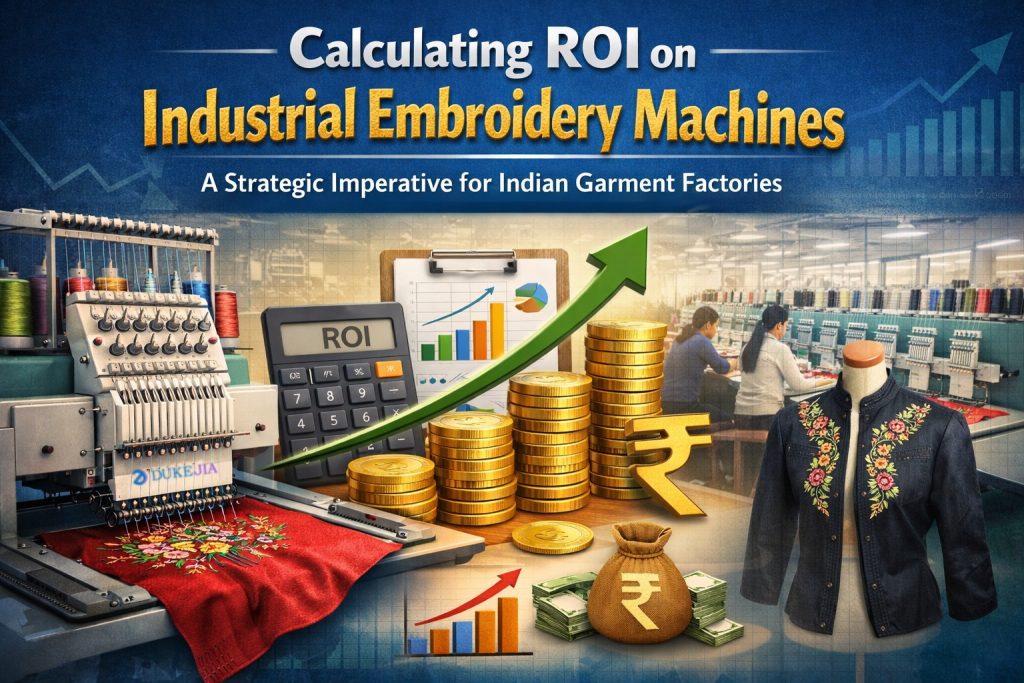
The machine shown above, an advanced industrial embroidery system, is installed in a modern garment factory, symbolizing the shift towards integrated value-addition processes that elevate product offerings and market positioning. This setup illustrates how investing in specialized machinery can directly translate into a competitive edge.
Calculating ROI on Embroidery Machines in Indian Factories
For any garment factory owner, production manager, or industrial engineer, understanding the return on investment (ROI) for new machinery is paramount. Industrial embroidery machines, far from being just fancy additions, are critical assets that unlock significant value, improve production metrics, and support higher margins in the Indian apparel market.
The Business Case for Industrial Embroidery
Industrial embroidery machines are versatile workhorses, finding application across a vast array of products:
- Apparel: T-shirts, polo shirts, knitwear, denim, jackets, activewear, uniforms, workwear, caps.
- Home Textiles: Bed linen, towels, curtains, upholstery.
- Accessories: Bags, patches, footwear components.
These machines solve several shop floor problems:
- Inconsistent Quality: Manual embroidery is slow and prone to errors; machines deliver precise, repeatable quality.
- Limited Design Scope: Complex, multi-color designs are easily achievable with digital programming.
- Low Production Speed: Multiple heads and high stitch per minute (SPM) rates drastically increase output.
- High Labor Dependency: Automation reduces the need for highly specialized manual labor, streamlining the process.
By addressing these issues, embroidery directly supports value-addition, allowing factories to command better Free On Board (FOB) prices or improve their profit margins on finished goods. It elevates basic garments into premium products, opening doors to new market segments and fulfilling specific brand requirements.
Understanding the Technology: How Industrial Embroidery Machines Work
At its core, an industrial embroidery machine creates designs by forming stitches using a needle and bobbin system, similar to a sewing machine, but with synchronized multi-axis movement.
Working Principle & Key Components:
A digitized design is loaded into the machine’s computer. The machine then interprets this data to control:
- Multi-head Configuration: Each head works simultaneously on a different garment, multiplying output.
- Needle Bar Assembly: Each head typically has multiple needles (e.g., 9, 12, 15, or more colors), allowing for automatic color changes without manual intervention.
- Hooping System: Garments are securely held in frames (hoops) that move precisely on X and Y axes under the stationary needle heads.
- Automatic Thread Trimmer: After each color change or design segment, a small cutter trims the thread, minimizing manual finishing.
- Servo Motors: Provide precise, high-speed control over the frame movement and needle bar actions, ensuring accuracy and efficiency.
- Central Control Panel: A user-friendly interface for design loading, parameter setting, and real-time monitoring.
Stitch Formation and Motion:
The machine forms a lockstitch, with the top thread passing through the fabric and interlocking with the bobbin thread underneath. The design’s complexity dictates the number of stitches. Industrial machines can achieve typical production capacities ranging from 700 to 1200 stitches per minute (SPM) per head, depending on the design complexity, fabric, and machine model. With multiple heads (e.g., a 20-head machine), production can be scaled exponentially.
Factors Influencing ROI: Costs and Benefits
Calculating ROI involves evaluating both the initial outlay and ongoing operational expenses against the generated revenue and cost savings.
1. Initial Investment:
- Machine Cost: Varies significantly based on brand, number of heads, features, and technology.
- Software & Digitization Tools: Essential for converting designs into machine-readable formats.
- Installation & Training: Crucial for smooth setup and skilled operator development.
2. Operating Costs:
- Power Consumption: Modern machines with servo motors are significantly more energy-efficient than older models, reducing electricity bills.
- Consumables: Embroidery thread, needles (appropriate type and size for fabric/design), backing/stabilizer material, bobbin thread, lubricants.
- Labor: Skilled operator wages. While investment is high, per-piece labor cost decreases significantly due to automation and speed.
3. Maintenance Costs:
- Preventive Maintenance (PM): Regular servicing extends machine life and prevents costly breakdowns.
- Spare Parts: Availability and cost of genuine spares are critical for minimizing downtime.
4. Revenue Generation & Benefits:
- Increased Per-Piece Value: Adding embroidery can increase garment FOB by 10-50% or more, depending on design and intricacy.
- Access to Premium Orders: Fulfilling high-value orders for brands demanding intricate embellishments.
- Reduced Rework & Wastage: High precision minimizes errors, leading to better material utilization.
- Faster Turnaround: High speed and automation enable quicker order fulfillment, meeting tight deadlines.
- Brand Differentiation: Offering unique, high-quality embroidered products strengthens market position.
Calculating Payback Period:
A simplified payback period can be calculated as:
- Payback Period (Years) = (Initial Investment) / (Annual Net Profit Increase from Embroidery)
- Annual Net Profit Increase = (Total Additional Revenue from Embroidery) – (Annual Operating & Maintenance Costs)
Advancements and Justifications: Modern vs. Older Machines
The evolution of industrial embroidery technology offers clear benefits, justifying investment in newer models.
Comparison: Older Generation vs. Modern Computerized Machines
| Feature | Older Generation Machines | Modern Computerized Machines |
|---|---|---|
| Speed & Precision | Lower SPM, mechanical limitations | High SPM (700-1200+), high accuracy via servo motors |
| Automation | Manual thread trimming, manual color change | Automatic thread trimming, automatic color change, needle threading |
| Pattern Memory | Limited, physical pattern cards/tapes | Large internal memory, USB input, network connectivity |
| Versatility | Restricted fabric types, simpler designs | Handles wider range of fabrics, complex 3D, cording, sequin, laser |
| Power Efficiency | Higher consumption (AC motors) | Lower consumption (efficient servo motors) |
| Operator Comfort | More manual intervention, higher skill demand | User-friendly interface, less physical strain |
| Data & Reporting | Minimal | Production data, error logs, maintenance reminders |
When Higher Automation is Justified:
- High-Volume Production: Factories with large orders for consistent designs benefit from multi-head, auto-trim, and auto-color change features, drastically cutting per-piece costs.
- Complex & Diverse Designs: Brands requiring intricate logos, appliqué, or specialized stitches (e.g., cording, sequin) need machines with advanced capabilities.
- Consistent Quality & Efficiency: To meet international standards and reduce manual intervention, automation is key.
When Basic Models are Enough:
- Niche Low-Volume Production: Smaller workshops focusing on custom orders or samples might find simpler, fewer-head machines sufficient.
- Budget Constraints: Where initial investment is a major hurdle, basic 1-head or 2-head machines can still offer significant value-addition over manual methods.
Daily Care and Troubleshooting for Optimal Performance
Proper maintenance is critical for longevity and consistent output.
Daily Maintenance:
- Clean Thread Path: Regularly remove lint and dust from tension discs, thread guides, and needle bar area.
- Oiling: Follow manufacturer guidelines for oiling rotary hooks, shafts, and other moving parts.
- Needle Inspection: Check needles for bends, burrs, or blunt tips. Replace regularly.
- Tension Checks: Ensure consistent top and bobbin thread tension for balanced stitches.
- Bobbin Case Cleaning: Remove lint from the bobbin case and hook area.
Common Faults & Basic Solutions:
| Fault | Likely Causes | Basic Solution |
|---|---|---|
| Thread Breakage | Incorrect tension, burrs on thread path, dull needle, poor thread quality, incorrect needle size | Adjust tension, clean path, replace needle, use quality thread, match needle to thread |
| Skipped Stitches | Wrong needle type/size, loose hooping, incorrect tension, fabric movement, timing issue | Use ballpoint for knits/sharp for wovens, re-hoop, adjust tension, check for fabric drag |
| Poor Stitch Quality | Unbalanced tension, dull needle, hooping issues, machine out of calibration | Balance tensions, replace needle, re-hoop, consult service for calibration |
| Machine Noises/Vibration | Lack of lubrication, loose components, worn parts, timing issues | Lubricate according to manual, check/tighten screws, consult service |
| Design Distortion | Improper hooping, fabric slipping, loose X/Y axis belts | Re-hoop securely, use proper stabilizer, check belt tension |
Selecting the Right Embroidery Machine: A Buying Guide
Making an informed decision ensures your investment yields the best ROI. Consider:
- Production Volume & Product Type: Do you need to embroider logos, intricate all-over designs, appliqué, or specialize in home textiles?
- Number of Heads & Needles per Head: Match this to your required output and color complexity.
- Stitch Area / Hoop Size: Ensure it accommodates your largest design requirements.
- Automation Features: Prioritize automatic trimming, color change, and networking based on labor costs and required efficiency.
- Software Compatibility: Ease of design loading and integration with existing systems.
- After-Sales Support: The availability of installation, training, preventive maintenance, genuine spares, and on-call service is crucial in India.
- Budget vs. Long-Term ROI: Don’t just look at the upfront cost; consider durability, power efficiency, and productivity gains over the machine’s lifespan.
Key Takeaways
- Industrial embroidery machines are essential for value-addition, increasing FOB and profit margins.
- ROI calculation must consider initial investment, operating costs (including power efficiency), maintenance, and significant revenue generation potential.
- Modern computerized machines offer superior speed, precision, automation, and energy efficiency compared to older models.
- Regular maintenance and prompt troubleshooting are vital for maximizing machine uptime and performance.
- Choosing the right machine involves assessing production needs, automation requirements, and robust after-sales support.
DukeJia & HCA: Your Partner in Value Addition
DukeJia, represented in India by Hari Chand Anand & Co. (HCA), is a trusted value-addition machinery partner for garment factories. We supply and service a comprehensive range of industrial embroidery, perforation, and quilting systems. Our machines support diverse applications, from intricate logo and placement embroidery on uniforms and fashion apparel, to expansive all-over quilting for jackets and home textiles, and precise laser perforation for advanced sportswear designs. Our commitment extends beyond sales, with strong after-sales support including professional installation, comprehensive operator training, scheduled preventive maintenance, availability of genuine spares, and responsive on-call service teams across India, covering key manufacturing hubs like Delhi NCR, Tirupur, Ludhiana, Chennai, and Bengaluru.
Frequently Asked Questions
What is the typical ROI for an industrial embroidery machine in India?
The ROI for an industrial embroidery machine can vary widely depending on factors like initial cost, utilization rate, market demand for embroidered products, and operational efficiency. However, with the ability to significantly increase per-piece value (10-50% or more) and reduce labor dependency, many factories see a payback period within 1 to 3 years. A detailed calculation considering all costs and benefits is recommended.
How do modern embroidery machines reduce operating costs?
Modern computerized machines, especially those equipped with servo motors, are far more energy-efficient than older models, leading to reduced electricity bills. Additionally, features like automatic thread trimming and color change minimize manual intervention, decreasing per-piece labor costs and improving overall production speed and consistency, thus reducing wastage and rework.
Can DukeJia machines handle specialized embroidery techniques like sequin or cording?
Yes, DukeJia offers advanced industrial embroidery systems capable of handling a wide range of specialized techniques, including sequin attachment, cording, appliqué, and 3D embroidery, catering to complex design requirements and enabling factories to offer diverse, high-value embellishments.
What kind of after-sales support does HCA provide for DukeJia machines?
Hari Chand Anand & Co. (HCA) provides comprehensive after-sales support for DukeJia machines across India. This includes professional installation, in-depth operator training, scheduled preventive maintenance, readily available genuine spare parts, and responsive on-call service teams in major manufacturing hubs like Delhi NCR, Tirupur, Ludhiana, Chennai, and Bengaluru.
Is a multi-head embroidery machine always better than a single-head machine?
Not necessarily. The choice depends on your production volume and specific needs. Multi-head machines are ideal for high-volume production of consistent designs, offering exponential output. Single-head or fewer-head machines might be sufficient and more cost-effective for smaller workshops, sampling, or niche low-volume custom orders, still providing significant value-addition over manual methods.
What is the importance of software and digitization tools for embroidery machines?
Software and digitization tools are crucial as they convert graphic designs into machine-readable embroidery files (digitizing). This process determines stitch types, density, colors, and sequence, directly impacting the final quality and efficiency of the embroidery. Good software allows for complex design creation, editing, and optimization, maximizing machine capabilities.
For DukeJia embroidery, perforation or quilting machine demonstrations, pricing or technical consultation, contact Hari Chand Anand & Co. (HCA), New Delhi.